October 17, 2026
How Often Do Half-Time Leads Hold? 2026/27 vs the Last 10 Seasons
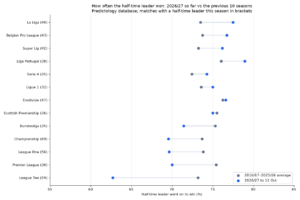
How often do half-time leads hold? Win, draw and defeat rates for half-time leaders in 13 leagues so far in...
Latency; in the world of high-stakes football betting, being “right” is only half the battle. You can have the most sophisticated Expected Goals (xG) model in existence, but if your execution is slow, the market will have already swallowed your edge before your bet is even processed.
Update, 14 October 2026: Autobet, which sent Predictology picks to BF Bot Manager, stops on 17 October 2026. The Bot Manager and automated-betting steps in this article won’t work with Predictology after that. Everything else in Predictology works as before.
In-play betting is a game of milliseconds. While most casual punters are watching a “live” stream that is actually 30 to 45 seconds behind the action, professional syndicates and automated bots are operating on data feeds that update in under 500 milliseconds. This gap: this latency: is the silent killer of ROI. If you are serious about moving from a hobbyist to a professional approach, you must understand that latency is the enemy.
To beat the market, you first need to understand the structural delays that exist between a player kicking a ball and your bet being confirmed on an exchange like Betfair. Most bettors think of “speed” as how fast they can click a button, but the reality is a cumulative “stack” of delays.
If you are betting while watching TV or a standard digital stream, you are effectively betting on the past. Digital broadcasts via satellite or cable typically have a delay of 10 to 20 seconds. OTT (Over-The-Top) streaming services like DAZN or YouTube TV can be delayed by as much as 60 seconds.
By the time you see a “Danger Ball” situation in the final third, the goal has likely already been scored, the market has suspended, and the odds have been completely recalibrated. Professional trading requires live data feeds: real-time digital pulses that bypass the visual broadcast entirely.
Even once the data is captured, it has to travel. This involves:
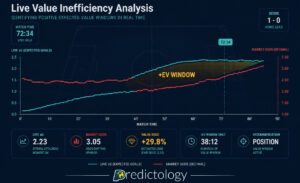
When you add these up, even a “fast” setup often faces a total system delay of 2 to 5 seconds. In a market where arbitrage margins are often thin (1% to 5%), a 2-second delay can turn a +EV bet into a losing one instantly.

In professional trading, we call the difference between your expected price and the price you actually get “slippage.”
When you use the Predictology System Builder to backtest a strategy, you are usually looking at historical closing prices or specific in-play benchmarks. However, in live markets, prices move with incredible velocity. If your model identifies value at 2.10, but by the time your bet hits the exchange the price has dropped to 2.04, you haven’t just lost 6 ticks: you may have lost your entire long-term edge.
Let’s look at the numbers. If your strategy has a theoretical yield of 5%, but slippage costs you an average of 0.02 in odds per bet, your real-world yield could drop to 2% or even turn negative.
This is why automation is no longer a luxury; it is a requirement for anyone betting in-play. Humans simply cannot react, calculate, and execute fast enough to compete with the price decay curve of modern football markets.

On exchanges like Betfair, there is a built-in “Bet Delay” (often referred to as the Red Clock) designed to protect market makers from people at the stadium with faster information. This delay is usually 5 to 8 seconds for football markets.
If you are betting manually, your total execution time looks like this:
In 9.5 seconds, a football match can change entirely. A corner is cleared, a player is fouled, or the momentum shifts, and the value you spotted is gone.
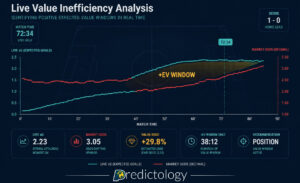
Our platform is built to minimize every possible microsecond of that timeline. By using Live Value Bet Finder and integrating with tools like BF Bot Manager, our members can achieve sub-second execution before the exchange delay even kicks in.
Our systems monitor 20,000+ tracked bets and use real-time xG data to identify spikes in pressure. When a “Value Index” threshold is hit, the signal is sent via API to your bot instantly. There is no manual navigation, no clicking, and no hesitation.

While you can’t eliminate the exchange’s built-in bet delay, you can optimize everything else. Here is how professional traders handle latency risk:
Never bet through a browser if you are trading in-play. Browsers have to render heavy HTML and JavaScript elements, which adds hundreds of milliseconds of lag. API connectivity allows your software to talk directly to the exchange server using lightweight data packets.
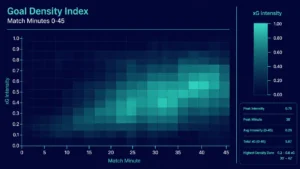
Instead of waiting for a goal to happen, use predictive metrics like Dangerous Attacks per Minute or xG momentum. By the time the goal is scored, the market is suspended anyway. The real value is found in the 30 seconds before the event, where the price hasn’t yet accounted for the rising pressure.
If your bot is running on a laptop in London but the exchange servers are in Dublin, your “ping” (the time data takes to travel) adds lag. Professional traders use a Virtual Private Server (VPS) located in the same data center as the exchange. This can reduce your network latency from 100ms down to 1ms.

It is important to acknowledge the limitations of even the fastest automation. Even with sub-second execution, you are still competing against “courtsiders”: individuals at the match who transmit data before it even hits the official feeds.
This is why we emphasize process and methodology over raw speed alone. Speed gets you the price, but your model determines if that price is actually worth taking. A fast bot that executes a bad strategy just loses money faster.
The goal is to pair award-winning analytics with automated execution. This combination ensures that when your model finds a +EV opportunity, you actually have the technical infrastructure to capture it.
If you are currently trading in-play, perform a simple “Latency Audit” this weekend:
In 2026, the “manual punter” is a relic of the past. The markets are too efficient, the data is too fast, and the margins are too tight. To survive, you must embrace the tools that eliminate human error and human lag.
Ready to level up your execution? Explore our LaunchPad resources to learn how to integrate Predictology with BF Bot Manager for lightning-fast automated trading.
October 17, 2026
How often do half-time leads hold? Win, draw and defeat rates for half-time leaders in 13 leagues so far in...
October 17, 2026
Favourites, draws and goals in 2026/27 so far compared with the previous 10 seasons across 13 leagues, from the Predictology...
October 17, 2026
Expected Goals (xG); many recreational bettors spend their Saturday afternoons fixated on the final whistle. They track full-time results, late...
October 17, 2026
In the world of football betting, 2026 marks a significant turning point. Just a few years ago, Expected Goals (xG)...
October 17, 2026
Expected Value (+EV) For the majority of football bettors, the live market is a whirlwind of emotion, reaction, and guesswork....
October 17, 2026
How often do half-time leads hold? Win, draw and defeat rates for half-time leaders in 13 leagues so far in...
October 17, 2026
Favourites, draws and goals in 2026/27 so far compared with the previous 10 seasons across 13 leagues, from the Predictology...
October 17, 2026
Expected Goals (xG); many recreational bettors spend their Saturday afternoons fixated on the final whistle. They track full-time results, late...
October 17, 2026
In the world of football betting, 2026 marks a significant turning point. Just a few years ago, Expected Goals (xG)...
October 17, 2026
Expected Value (+EV) For the majority of football bettors, the live market is a whirlwind of emotion, reaction, and guesswork....
Join the Discussion
We respect your privacy — your email won’t be shown. Fields marked * are required.