April 21, 2026
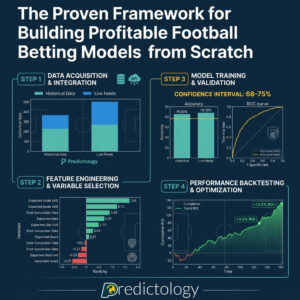
The Proven Framework for Building Profitable Football Betting Models from Scratch
Build your own profitable football betting models from scratch. Our proven framework covers data analysis, system building, and backtesting for...
In-Play Football Betting; in the world of professional sports trading, the transition from pre-match analysis to in-play execution is where the most significant edges are found. While pre-match markets are often highly efficient: priced accurately by bookmakers using vast historical datasets: the live environment is fluid, emotional, and prone to temporary inefficiencies. Creating a winning […]
In-Play Football Betting; in the world of professional sports trading, the transition from pre-match analysis to in-play execution is where the most significant edges are found. While pre-match markets are often highly efficient: priced accurately by bookmakers using vast historical datasets: the live environment is fluid, emotional, and prone to temporary inefficiencies.
Creating a winning in-play football betting strategy doesn’t require hours of manual tracking if you have the right framework. In fact, you can build a robust, data-driven system in under five minutes by focusing on three pillars: momentum metrics, market selection, and strict bankroll math. At Predictology, we focus on turning raw data into actionable systems that remove the “guesswork” from the live betting experience.
The biggest mistake most casual bettors make is betting based on the “eye test” alone. While watching a match provides context, human bias often leads us to see patterns that aren’t there. A team might look dominant because they have 70% possession, but if that possession is happening in their own half, the probability of a goal remains low.
To create a strategy in five minutes, you must move away from subjective “feel” and toward objective triggers. A strategy is simply a set of “If-Then” statements:
By defining these parameters beforehand, you eliminate the emotional fatigue that comes with live trading.

Momentum in football is often described as a wave. One team pins the other back, earns a succession of corners, and creates “big chances.” Eventually, the defensive structure tires, and the probability of a goal spikes. To capture this in a strategy, you need to look at specific real-time indicators.
Possession is a “noisy” stat. A more accurate measure of momentum is “Dangerous Attacks” or “Final Third Entries.” If a team is trailing but their dangerous attacks are increasing at a rate of 2:1 compared to their opponent, the market often lags in adjusting the odds for a comeback. We look for matches where the “live” performance deviates significantly from the pre-match expectation.
Professional analysts use a Pressure Index to quantify momentum. This usually aggregates shots on target, corners, and possession in the final third over a rolling 10-minute window. When you see a sustained spike in this index, it is often a precursor to a goal. In your five-minute strategy setup, you should decide which momentum thresholds act as your “green light” for entry.
Not all markets are created equal when the clock is ticking. For a rapid strategy build, focus on markets where the “time decay” works in your favor or where the exit strategy is clear.
The classic “Lay the Draw” strategy involves betting against a draw and exiting when a goal is scored. However, the “5-minute” pro version involves filtering for specific match states. For example, look for games that are 0-0 at half-time where the pre-match favorite was priced at 1.50 or lower. The data shows that high-utility favorites rarely finish 0-0. By entering the “Lay” at the 46th or 60th minute, you get much better value than entering at kick-off.
The “Over 1.5 Goals” or “Next Goal” markets between the 70th and 85th minutes are hunting grounds for value. As teams chase a result or fatigue sets in, the game stretches. If your data indicates a high xG for both teams but the score is 1-0, the “Over 1.5” market often offers +EV (Expected Value) because the market overestimates the defensive capabilities of a tired trailing team.

Expected Goals (xG) has revolutionized pre-match analysis, but its true power lies in-play. xG measures the quality of chances created. If a match is 0-0 at the 70th minute, but the cumulative xG is 2.4, you are looking at a statistical anomaly. The teams are creating high-quality chances, but they haven’t converted: yet.
In this scenario, the “0-0” scoreline is “fake” in a statistical sense. Regression to the mean suggests a goal is highly probable. Incorporating xG filters into your Predictology models allows you to identify these anomalies instantly across hundreds of live matches, something a human observer could never do manually.
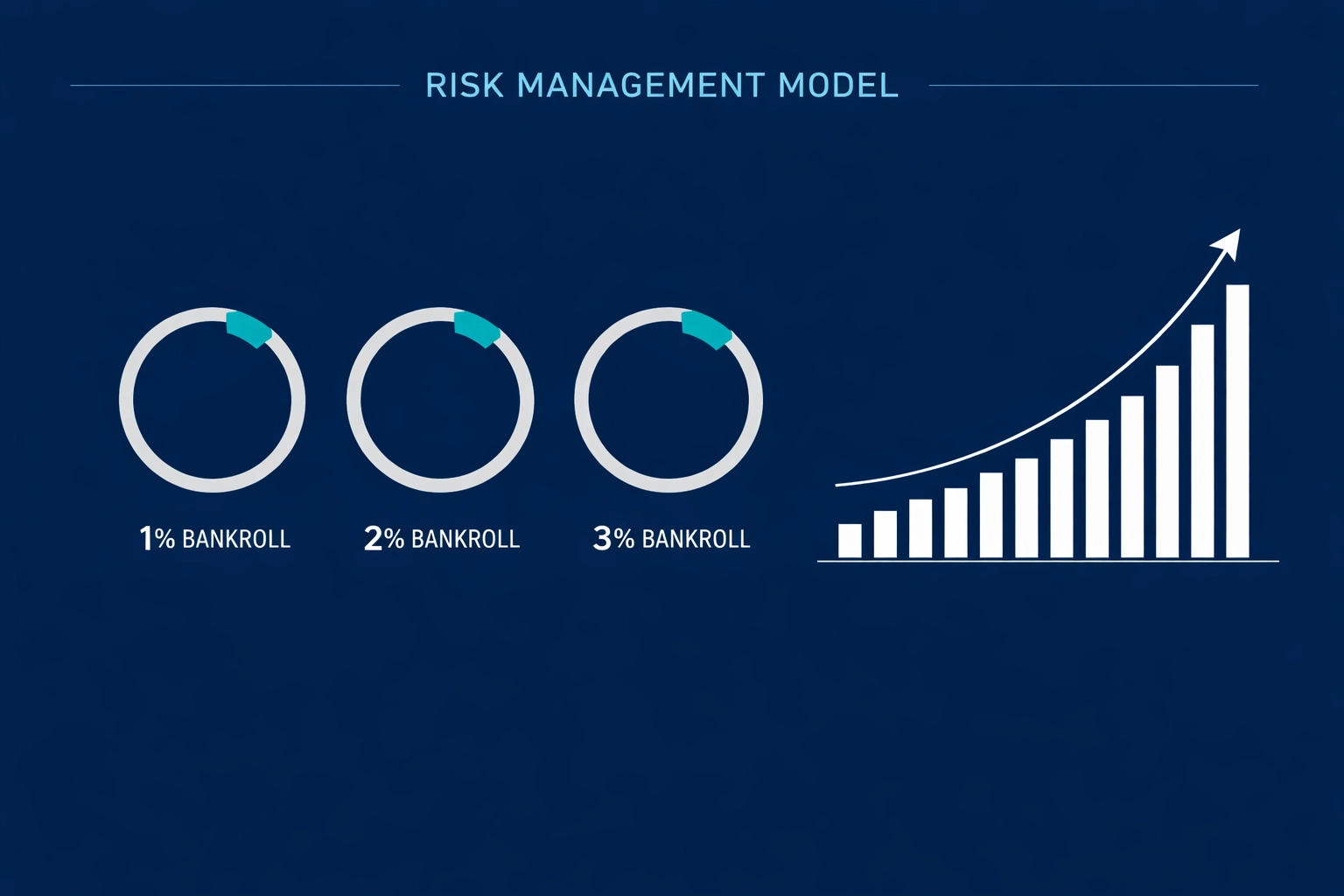
Even the most sophisticated in-play football betting strategy will fail without a mathematical safety net. Football is high-variance; even a 90% probability event can fail to happen in a single game.
Professional bettors generally stick to a 1% to 3% stake of their total bankroll per trade.
Never chase losses by increasing your stake in the next live match. In-play football betting moves fast, and “revenge betting” is the quickest way to ruin. If you are interested in avoiding the most common pitfalls, read our guide on 7 mistakes you’re making with betting automation and how to fix them.
The reality of 2026 is that the fastest edges are captured by those who use technology to monitor the markets. While you can create the logic of a strategy in five minutes, executing it manually across 50 matches on a Saturday afternoon is impossible.
This is where Predictology’s Sports Analytics & Betting Technology comes in. Our platform allows you to:
Automation ensures that you never miss a value entry because you were busy watching a different game. It brings a level of professional rigor to your betting that separates the hobbyist from the specialist.
To build your first in-play football betting strategy today, follow this checklist:
In-play football betting is not about predicting the future; it is about reacting to the present with more accuracy than the market. By using a structured framework and leveraging the data tools available at Predictology, you can turn five minutes of planning into a long-term professional edge.
For more insights into how to refine your betting systems, visit our Insights & Tutorials section.
April 21, 2026
Build your own profitable football betting models from scratch. Our proven framework covers data analysis, system building, and backtesting for...
April 21, 2026
Looking for the best value betting software? Before you buy, read our guide on the 10 essential things you need...
April 21, 2026
The Evolution of In-Play Data Live xG; for decades, in-play football trading was guided by a combination of the “eye...
April 21, 2026
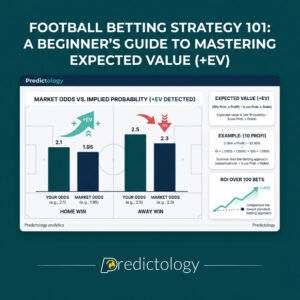
Expected Value +EV; most football fans approach betting with a single question: “Who is going to win this match?” If...
April 21, 2026
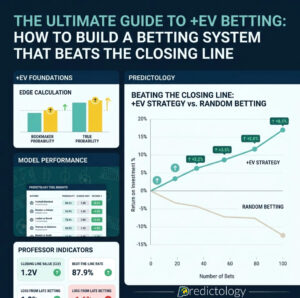
+EV Betting; for the vast majority of sports bettors, the primary focus is on “who will win the game.” They...
April 21, 2026
Build your own profitable football betting models from scratch. Our proven framework covers data analysis, system building, and backtesting for...
April 21, 2026
Looking for the best value betting software? Before you buy, read our guide on the 10 essential things you need...
April 21, 2026
The Evolution of In-Play Data Live xG; for decades, in-play football trading was guided by a combination of the “eye...
April 21, 2026
Expected Value +EV; most football fans approach betting with a single question: “Who is going to win this match?” If...
April 21, 2026
+EV Betting; for the vast majority of sports bettors, the primary focus is on “who will win the game.” They...
Join the Discussion
We respect your privacy — your email won’t be shown. Fields marked * are required.