September 20, 2026
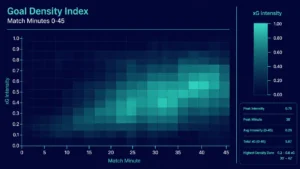
Beyond the Full-Time Result: Profiting from 1st Half Goals and xG Trends
Expected Goals (xG); many recreational bettors spend their Saturday afternoons fixated on the final whistle. They track full-time results, late...
The promise of betting automation is seductive: hands-free execution, removal of emotional bias, and the ability to scale strategies across thousands of matches while you sleep. For many traders and bettors, moving toward automated football betting feels like the natural evolution from manual analysis.
However, the transition from a manual system-builder to an automated executioner is fraught with technical and psychological pitfalls. Technology does not make a bad strategy good; it only makes a bad strategy lose money faster. To succeed in the modern sports markets, you must treat your automation as a business process, not a magic money machine.
In this guide, we break down the seven most common mistakes bettors make when automating their systems and, more importantly, how to correct them to ensure long-term sustainability.
The biggest misconception in betting automation is that once the bot is live, your job is over. This “passive income” dream often leads to disaster. Markets are dynamic; what worked in the 2023/24 Premier League season may not work in 2026 due to tactical shifts, rule changes, or market efficiency.
Even the most robust automated football betting models require regular oversight. Professional operators treat their bots like employees: they need performance reviews. If you aren’t monitoring your closing line value (CLV) or checking for execution errors, you are flying blind.
The Fix: Schedule a weekly “System Audit.” Review the discrepancy between your expected results and actual returns. Look for “drift”: where the model’s logic starts to lose its edge against current market prices.
As noted in industry research, sportsbooks themselves often fail when they rely too heavily on automated feeds without human intervention. The same applies to you. A misaligned odds feed or a late market closure can cause your bot to fire on “ghost” value that doesn’t actually exist. Always maintain a manual override capability.

When using a System Builder, it is tempting to add filter after filter until your historical ROI looks like a vertical line. This is known as “curve fitting.”
If your strategy only works when it’s a Tuesday, raining, and the away team’s striker has a haircut on a Monday, you haven’t found a pattern; you’ve found a coincidence. In betting automation, simplicity often scales better than complexity. The more variables you add, the more likely you are to be modeling “noise” rather than actual “signal.”
The Fix: Use a “Hold-out Sample” for testing. Build your strategy on 70% of your data (the training set) and then test it on the remaining 30% (the validation set) that the model has never seen. If the performance drops significantly on the unseen data, your model is over-optimized.
A strategy can look incredible on paper using “Opening Odds,” but in the real world of betting automation, execution is everything.
Slippage occurs when your bot attempts to place a bet, but the market moves, or there isn’t enough liquidity to fill your stake at the requested price. If your system relies on thin margins (e.g., a 3% ROI), a 2-tick drop in odds due to poor execution can turn a winning system into a losing one instantly.
The Fix: Incorporate a “Minimum Liquidity” filter in your automation settings. If you are using tools like the BF Bot Manager integration, ensure you set parameters that prevent the bot from placing bets if the available volume is too low or the spread is too wide.
Many automated systems are designed to “win often” rather than “win value.” It feels good to see a bot hit 80% of its bets, but if those bets are at odds of 1.15, you are mathematically destined to fail over the long run.
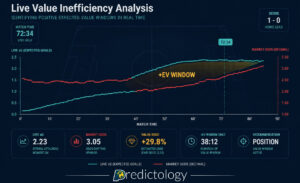
The core of professional betting is Expected Value (EV). An automated system must be looking for discrepancies between the probability of an event and the odds offered by the market. If you ignore the price and only focus on the outcome, you aren’t automating an investment; you’re automating a hobby.
The Fix: Shift your metrics. Instead of looking at “Win Rate,” look at your yield against the “Closing Line.” If you are consistently beating the final odds offered by the market, you have a winning automated process, regardless of short-term variance. You can learn more about this in our deep dive on Value Betting Models.
Modern automated football betting should rely on advanced metrics like xG (Expected Goals). While raw results can be fluky, xG provides a more stable representation of a team’s performance. Automating based on xG trends allows you to find value before the rest of the market catches up to the underlying reality.
Automation allows you to place a high volume of bets, which is great for reaching the “long run” faster. However, high volume requires a much more robust bankroll strategy.
Many bettors use a flat staking plan that is too aggressive for the variance of their system. Because bots don’t feel “pain,” they will happily place 50 bets in a Saturday afternoon. If those bets are correlated (e.g., all based on Home Wins in the same league), a “bad day” can wipe out a significant portion of your capital before you even realize it.
The Fix: Use a fractional Kelly Criterion or a very conservative flat stake (e.g., 0.25% to 0.5% of bankroll per bet). Furthermore, set a “Daily Loss Limit” in your automation software. This acts as a circuit breaker in case the market experiences an outlier event or your data feed encounters an error.
If your betting automation relies solely on basic league tables or recent form, you are competing with every other recreational bettor and the bookmakers’ highly sophisticated algorithms.
Relying on a single source of truth is a structural weakness. If that data feed is delayed by even a few seconds, or if it fails to account for a key injury, your bot is essentially guessing. Professional automation requires layers of data: statistical, situational, and market-based.
The Fix: Diversify your inputs. Combine xG analysis with market movement data. Use the Predictology System Builder to cross-reference multiple variables before a trigger is met. The more independent signals you have confirming a “Value Bet,” the more robust your automation becomes.
In the world of algorithmic trading, every system has a “Kill Switch.” In sports betting automation, many people forget this.
Technical errors happen. API connections drop, servers reboot, and odds feeds can freeze. Without a protocol for what happens when things go wrong, you could end up with “unhedged” positions or duplicate bets. If your bot loses its connection to the exchange halfway through a sequence, do you have a way to neutralize your exposure?
The Fix: Always run your automation on a dedicated VPS (Virtual Private Server) rather than a home laptop to ensure 99.9% uptime. Additionally, set up “Alerts” to your phone for every trade placed or every time an error log is generated.
Automation is a tool, not a strategy. The goal is to free up your time so you can focus on research and strategy development, rather than the mechanical act of placing bets.

To move from an amateur bot-user to a professional automated bettor, you must stop looking for “winners” and start looking for “processes.”
Betting automation is the future of the industry. By avoiding these seven common mistakes, you position yourself ahead of 95% of the market. The edge is there for those who treat the technology with the respect it deserves.
Next Step: Review your current automated systems. Are you tracking your Closing Line Value? If not, start there. Compare your average odds taken to the final market price to see if you truly have an edge.
September 20, 2026
Expected Goals (xG); many recreational bettors spend their Saturday afternoons fixated on the final whistle. They track full-time results, late...
September 20, 2026
In the world of football betting, 2026 marks a significant turning point. Just a few years ago, Expected Goals (xG)...
September 20, 2026
Expected Value (+EV) For the majority of football bettors, the live market is a whirlwind of emotion, reaction, and guesswork....
September 20, 2026
System Builder; for most football bettors, the journey starts with a gut feeling. You see a home team with a...
September 20, 2026
Analytics; to move from a casual punter to a professional bettor, you must transition from making “picks” to executing a...
September 20, 2026
Expected Goals (xG); many recreational bettors spend their Saturday afternoons fixated on the final whistle. They track full-time results, late...
September 20, 2026
In the world of football betting, 2026 marks a significant turning point. Just a few years ago, Expected Goals (xG)...
September 20, 2026
Expected Value (+EV) For the majority of football bettors, the live market is a whirlwind of emotion, reaction, and guesswork....
September 20, 2026
System Builder; for most football bettors, the journey starts with a gut feeling. You see a home team with a...
September 20, 2026
Analytics; to move from a casual punter to a professional bettor, you must transition from making “picks” to executing a...
Join the Discussion
We respect your privacy — your email won’t be shown. Fields marked * are required.