October 17, 2026
How Often Do Half-Time Leads Hold? 2026/27 vs the Last 10 Seasons
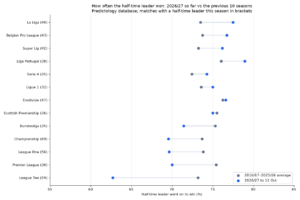
How often do half-time leads hold? Win, draw and defeat rates for half-time leaders in 13 leagues so far in...
Football Betting Systems; we’ve all been there. You spend hours: maybe days: scouring spreadsheets, looking at league tables, and convinced you’ve found the “holy grail.” You’ve spotted a pattern where home favorites in the Bundesliga 2 coming off a loss always seem to win the next game. You put your money down, and… it fails. Repeatedly.
Building a winning football betting system is hard. If it were easy, bookmakers would be out of business and we’d all be retired on a beach in Spain. The reality is that most systems fail not because the logic is entirely wrong, but because the foundation they are built on is statistically flimsy.
At Predictology, we’ve analyzed over 400,000 matches to help bettors move away from “gut feelings” toward data-driven precision. If your systems are hitting a brick wall, here are 10 reasons why: and how you can fix them.
This is the silent killer of most betting systems. Curve fitting happens when you add so many filters to your backtest that you are essentially describing what happened in the past perfectly, but creating a model with zero predictive power for the future.
If your system only works when “the temperature is below 15 degrees, it’s a Tuesday, and the left-back has a haircut,” you haven’t found a trend; you’ve found a coincidence.
The Fix: Keep your systems simple. Use variables that have a logical impact on the game: like xG (Expected Goals), shot dominance, or squad rotation. At Predictology, our System Builder allows you to test variables across massive datasets to see if a trend holds up under pressure or if it’s just a statistical ghost.
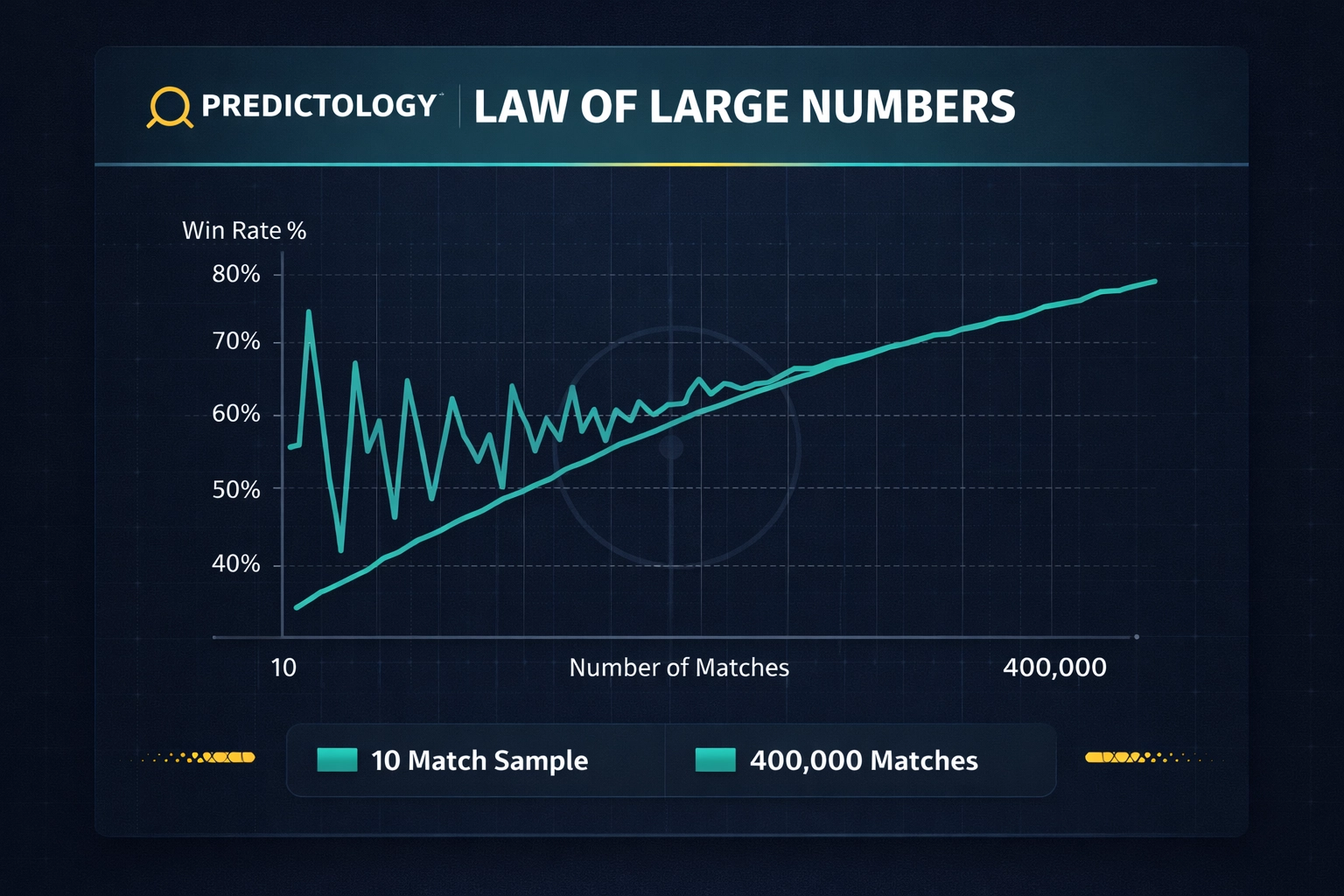
A system that has won 8 out of 10 bets isn’t necessarily a good system; it might just be a lucky one. In the world of sports analytics, small sample sizes are dangerous because they are heavily influenced by “noise.”
If you develop a strategy based on the last three weeks of the Premier League, you are ignoring the law of large numbers. A strategy needs hundreds, if not thousands, of data points to prove its viability.
The Fix: Backtest over multiple seasons and different leagues. Use Predictology’s database of 400,000+ matches to ensure your “winning” trend wasn’t just a two-week fluke. If a system doesn’t work over three seasons, it won’t work next month.
Variance is the “swing” between your expected results and your actual results. Even the most profitable +EV (Expected Value) systems in the world will have losing streaks. Professional bettors understand that they might lose 10 bets in a row even if their system has a 60% win rate.
Most amateur bettors scrap a perfectly good system the moment they hit a “drawdown” (a losing streak). They assume the system is broken when, in reality, it’s just standard statistical variance.
The Fix: Calculate your expected drawdown before you start. Use historical data to see the longest losing streak your system encountered in the past. If you know a 7-game losing streak is possible, you won’t panic when it happens.
The most accurate reflection of a match’s probability is the “Closing Line”: the odds offered by the bookmakers just before kick-off. If you are consistently betting at odds of 2.00, but the market closes at 1.85, you are finding “Value.”
If your system ignores whether you are beating the market price, you are likely just getting lucky with short-term results.
The Fix: Track your “Closing Line Value” (CLV). If your system consistently picks prices higher than the closing odds, you are on the path to long-term profit, regardless of the result of a single match.
Relying on basic league tables or “last five games” form is what the bookmakers want you to do. That information is already baked into the price. To find an edge, you need deeper insights: metrics that tell the story of the game better than the final score.
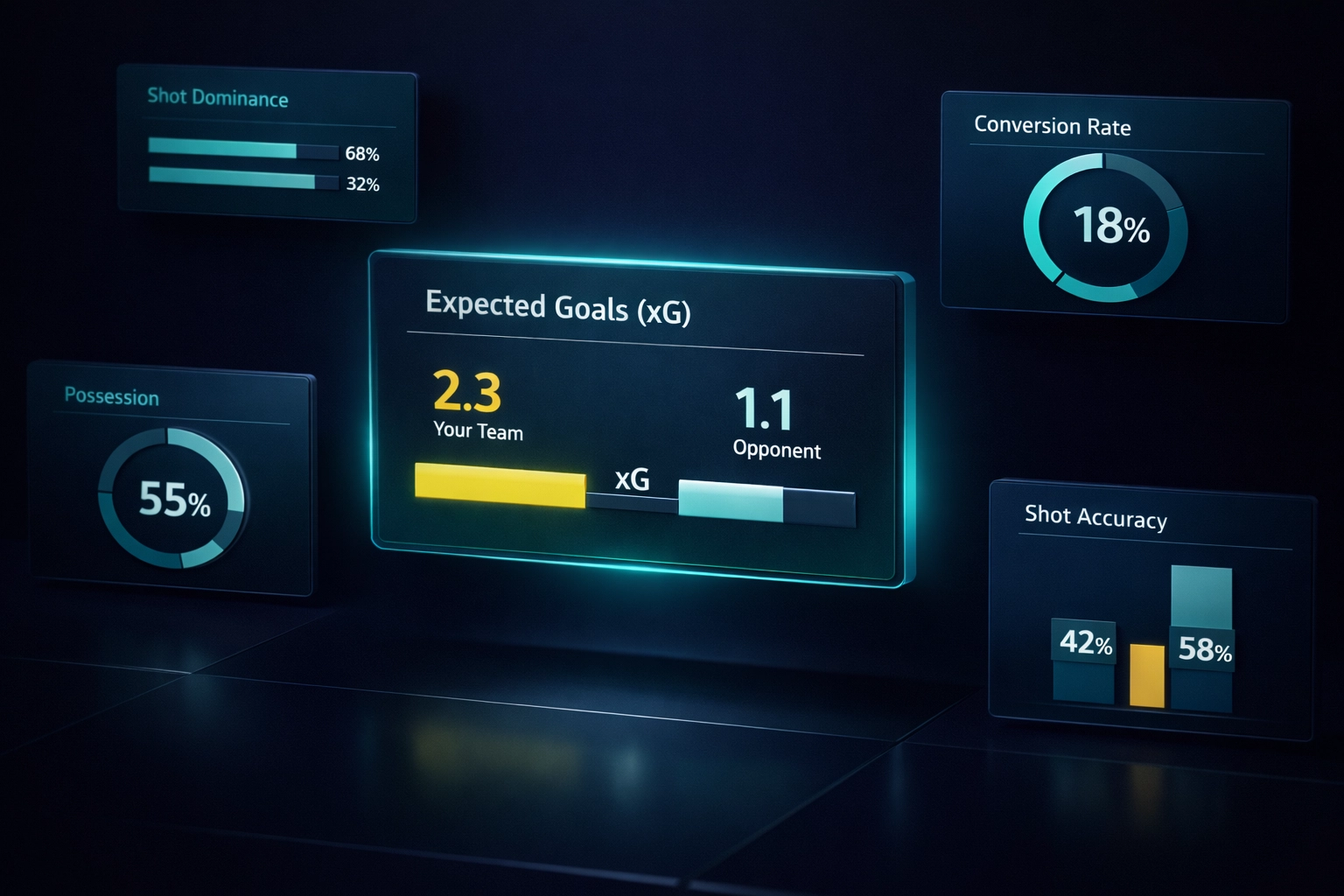
A team might win 1-0 but have been outplayed, conceding 2.5 xG while only creating 0.3. The “form” says they are winning; the “data” says they are lucky.
The Fix: Use advanced sports analytics. Our platform integrates sophisticated data models that look beyond the scoreline, helping you identify teams that are overperforming or underperforming relative to their actual output on the pitch.
Humans are hardwired to look for information that supports what we already believe. If you think Arsenal are going to win, you will subconsciously ignore the injury report that says their key playmaker is out.
In betting systems, this often manifests as “cherry-picking” data. You ignore the seasons where your system lost and focus only on the ones where it won.
The Fix: Let the data speak first. Build your criteria in the System Builder before looking at the upcoming fixtures. This removes the emotional “I want this team to win” element from the equation.
A system that shows a 3% Return on Investment (ROI) looks great on paper. However, if you are betting on a betting exchange like Betfair and forget to account for a 2% or 5% commission on winnings, your profit evaporates. Similarly, if you only use one bookmaker, you are losing money by not shopping for the best price.
The Fix: Always account for commissions in your backtesting. Furthermore, small increases in odds (e.g., taking 2.05 instead of 2.00) can be the difference between a losing system and a winning one over a year.
The betting market is a “prediction engine.” As more money enters the pool, the odds become more accurate. Major markets like the English Premier League or the Champions League are incredibly “efficient,” meaning it is very hard to find a mistake in the bookmaker’s pricing.
If your system is built on these major leagues using basic stats, you are competing against some of the smartest mathematical models in the world.
The Fix: Consider “niche” markets or specific betting types (like Asian Handicaps or Over/Under goals) where the market might not be as sharp. Alternatively, use tools like Predictology to find data angles in secondary leagues that the big syndicates might be overlooking.
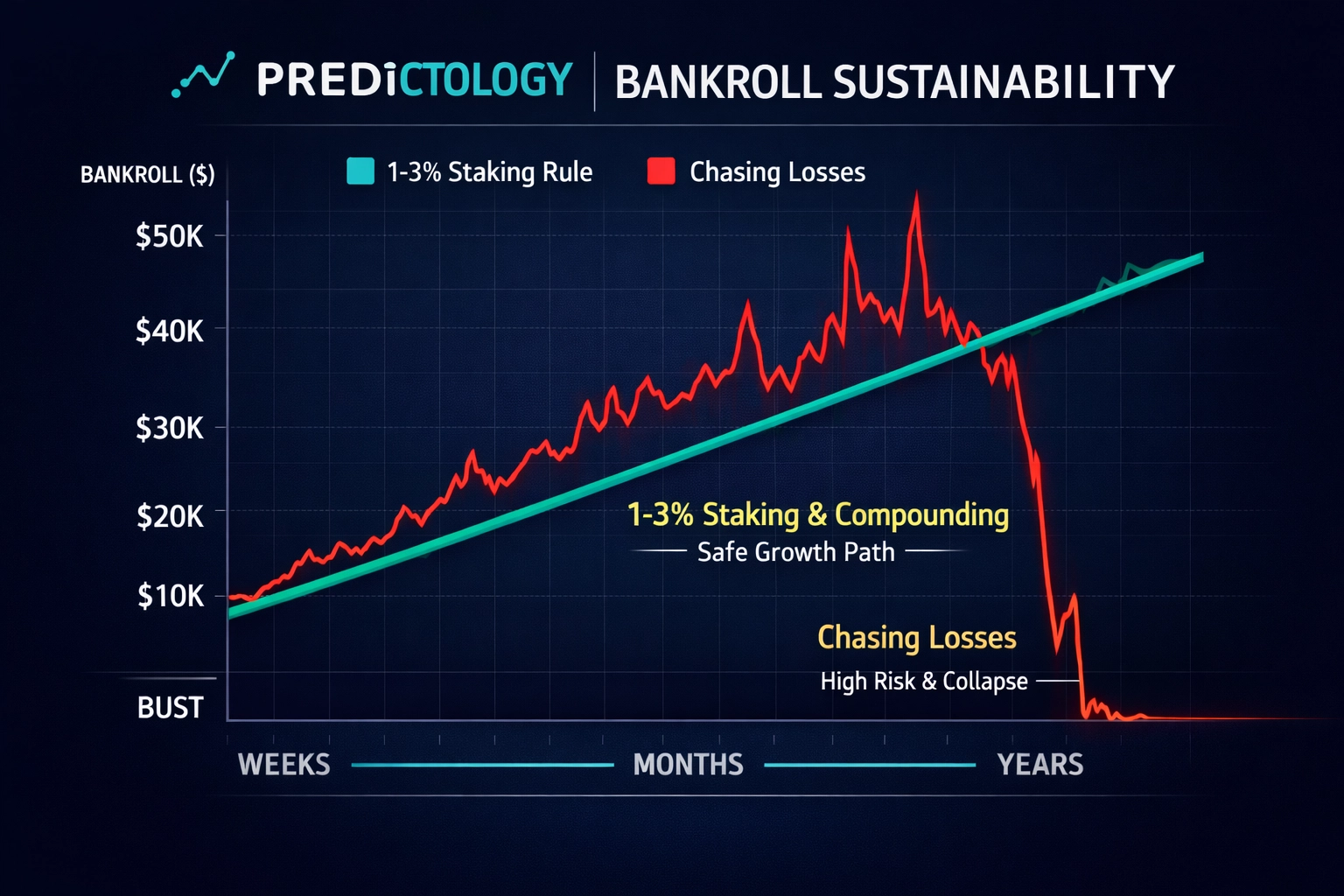
You can have the best system in the world, but if your staking plan is “whatever I feel like today,” you will eventually go broke. Many bettors “chase” losses by increasing their stakes after a bad run, which is a one-way ticket to a zero balance.
The Fix: Stick to a disciplined staking plan. Usually, this means betting between 1% and 3% of your total bankroll on any single selection. This ensures that a natural losing streak doesn’t wipe you out before the “regression to the mean” kicks in.
Football changes. Tactics evolve (think of the rise of high-pressing or “inverted fullbacks”), and the betting markets adjust to these changes. A system that worked in 2018 might be obsolete in 2026 because the market has “priced in” the variables you were using.
The Fix: Continuous monitoring and refinement. You should treat your betting systems like a garden: they need regular weeding and maintenance. Review your performance every month and check if the underlying assumptions of your system still hold true.
Creating a football betting system is a process of trial, error, and statistical rigor. Most bettors fail because they look for “shortcuts” or “patterns” that don’t actually exist. By focusing on large sample sizes, avoiding over-optimization, and using high-quality data, you put yourself ahead of 95% of the betting public.
Your Next Step:
Don’t build your next system on a hunch. Use the Predictology System Builder to run your ideas through our database of over 400,000 matches. See if your logic holds up over 10 years of data before you risk a single penny of your bankroll.
The goal isn’t to be right today; it’s to be profitable over the long term. Stop guessing and start analyzing.
October 17, 2026
How often do half-time leads hold? Win, draw and defeat rates for half-time leaders in 13 leagues so far in...
October 17, 2026
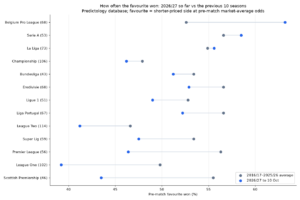
Favourites, draws and goals in 2026/27 so far compared with the previous 10 seasons across 13 leagues, from the Predictology...
October 17, 2026
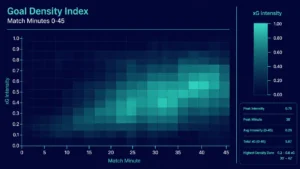
Expected Goals (xG); many recreational bettors spend their Saturday afternoons fixated on the final whistle. They track full-time results, late...
October 17, 2026
In the world of football betting, 2026 marks a significant turning point. Just a few years ago, Expected Goals (xG)...
October 17, 2026
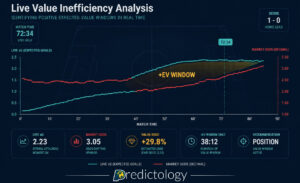
Expected Value (+EV) For the majority of football bettors, the live market is a whirlwind of emotion, reaction, and guesswork....
October 17, 2026
How often do half-time leads hold? Win, draw and defeat rates for half-time leaders in 13 leagues so far in...
October 17, 2026
Favourites, draws and goals in 2026/27 so far compared with the previous 10 seasons across 13 leagues, from the Predictology...
October 17, 2026
Expected Goals (xG); many recreational bettors spend their Saturday afternoons fixated on the final whistle. They track full-time results, late...
October 17, 2026
In the world of football betting, 2026 marks a significant turning point. Just a few years ago, Expected Goals (xG)...
October 17, 2026
Expected Value (+EV) For the majority of football bettors, the live market is a whirlwind of emotion, reaction, and guesswork....
Join the Discussion
We respect your privacy — your email won’t be shown. Fields marked * are required.