October 24, 2026
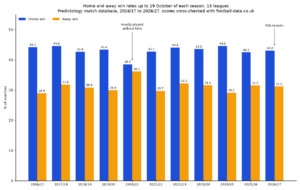
Home Advantage in 2026/27 vs the Last 10 Seasons
How strong is home advantage this season? Home, draw and away win rates in 13 leagues so far in 2026/27,...
Expected Goals; in the world of professional football trading, data is the only currency that truly matters. While casual punters are chasing “gut feelings” or reacting to a single goal, professional traders are looking at the underlying mathematics of the game. One of the most debated topics in our community is the utility of Expected Goals (xG) timing: should you base your trades on the data from the first 45 minutes, or wait for the second-half trends to emerge?
The answer isn’t as simple as picking one over the other. Instead, it’s about understanding how the predictive power of xG shifts as the clock ticks toward the 90th minute. In this guide, we’ll break down the statistical differences between halves and show you how to use Predictology’s tools to find market inefficiencies.

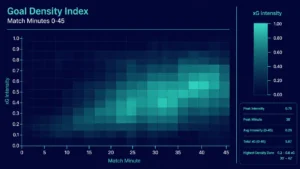
If you’ve spent any time looking at historical football data, you know that goals are not distributed evenly across a match. Statistically, the second half is significantly more productive than the first.
Data across the major European leagues shows a consistent pattern: 55% to 60% of all goals occur in the second half. On average, we see approximately 1 goal in the first half compared to 1.5 goals in the second.
This increase is driven by three primary factors:

Because there is a higher frequency of goals in the second half, the xG accumulated during this period often has a more direct correlation to actual goals. However, that doesn’t mean the first-half data is useless. In fact, it’s your most valuable lead indicator.
The real “secret sauce” in in-play trading is using first-half performance to predict second-half outcomes. This is where most traders fail: they look at the halftime score (0-0) and assume the game is “dead.”
At Predictology, we view 1st half xG as a “pressure gauge.” If a match is 0-0 at halftime but the accumulated xG is 1.1 or higher, the market often underprices the probability of a goal in the second half. The odds drift because the scoreline remains static, but the underlying data suggests that high-quality chances are being created.
Statistically, a match that is 0-0 at halftime with a high xG has a significantly higher probability of at least one second-half goal (often exceeding 80%) compared to a 0-0 game where the xG is low (0.2 – 0.4). By identifying these mismatches, you can find high-value entries in the Over 0.5 or Over 1.5 goal markets before the price corrects.

To master in-play trading, you must understand Game State. This is the current score of the match and how it influences team behavior. xG data is not “static”; it is heavily influenced by who is winning and who is losing.
When a favorite is trailing at home in the 60th minute, their xG output typically spikes. Conversely, a team leading 3-0 may see their xG flatline as they move into a “preservation” mode, keeping the ball but not taking risks.
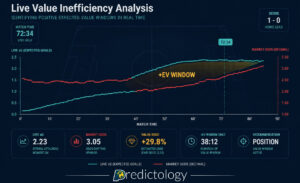
The most profitable in-play opportunities occur when the market overreacts to the game state. For example, if a heavy favorite is drawing 1-1 and their xG is rising sharply, the “Draw” price might be too low because the market isn’t accounting for the massive pressure being applied. Using the Live Value Bet Finder allows you to see these discrepancies in real-time.
So, which is better? The answer is: 1st Half xG is better for finding value entries, while 2nd Half xG is better for confirming high-probability exits.
Here is a 3-step process to combine them:
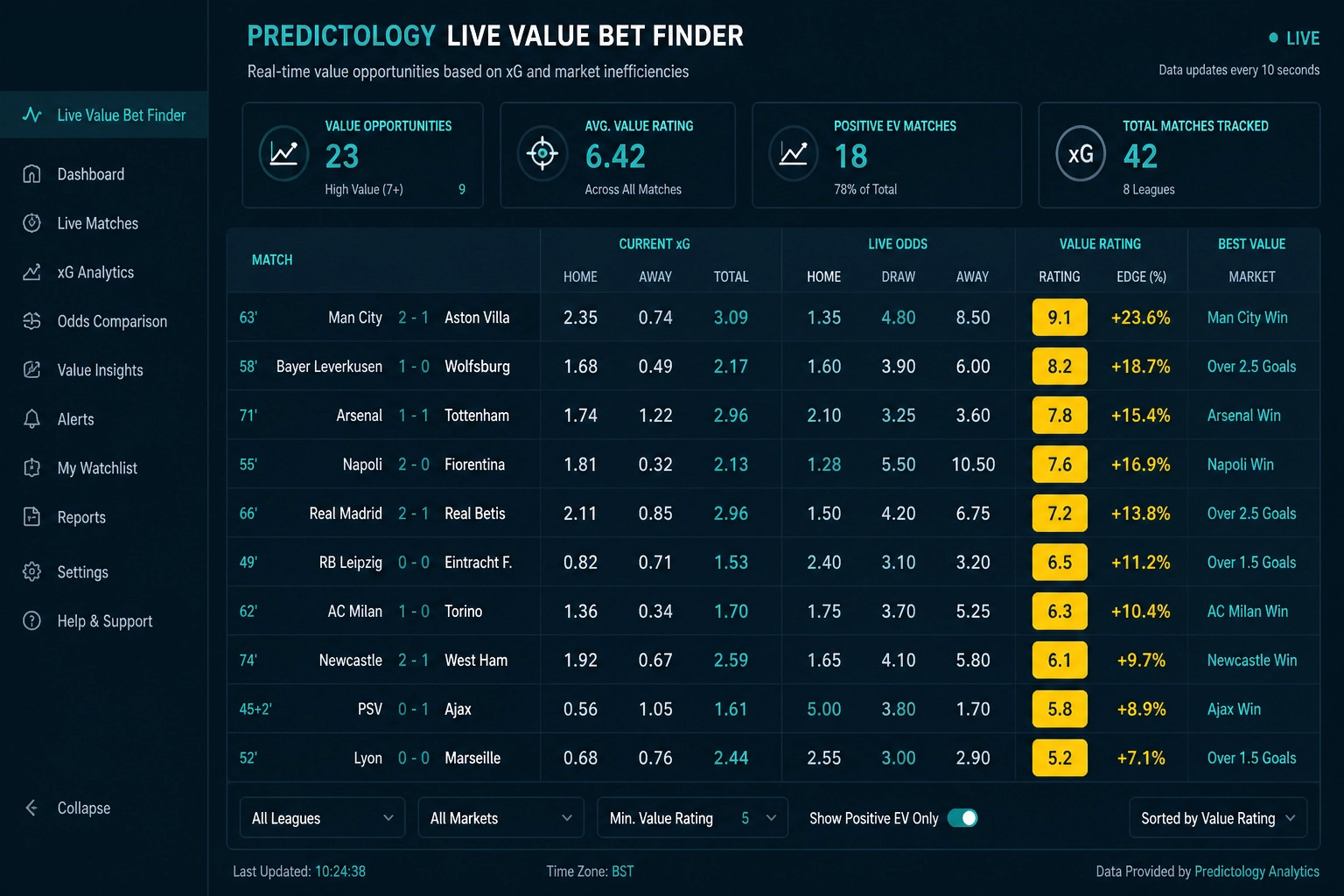
While second-half xG is a more accurate reflection of final goal outcomes due to the sheer volume of late-game action, first-half xG is the superior tool for value identification.
Professional trading isn’t about predicting what will happen; it’s about identifying when the probability of an event is higher than what the odds suggest. By using the first 45 minutes as your research phase, you can enter the second half with a mathematical edge that the average bettor simply doesn’t have.
Practical Takeaway: Next time you see a 0-0 at halftime, don’t ignore it. Log into your Predictology dashboard, check the xG pressure, and see if the market has “fallen asleep” on a game that is primed for goals.
Want to start building your own data-driven models? Check out our LaunchPad educational resources to master the art of football analytics.
October 24, 2026
How strong is home advantage this season? Home, draw and away win rates in 13 leagues so far in 2026/27,...
October 24, 2026
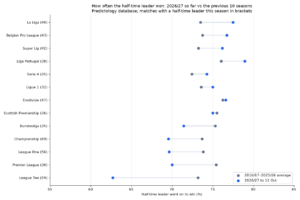
How often do half-time leads hold? Win, draw and defeat rates for half-time leaders in 13 leagues so far in...
October 24, 2026
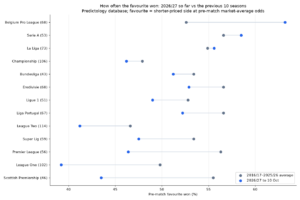
Favourites, draws and goals in 2026/27 so far compared with the previous 10 seasons across 13 leagues, from the Predictology...
October 24, 2026
Expected Goals (xG); many recreational bettors spend their Saturday afternoons fixated on the final whistle. They track full-time results, late...
October 24, 2026
In the world of football betting, 2026 marks a significant turning point. Just a few years ago, Expected Goals (xG)...
October 24, 2026
How strong is home advantage this season? Home, draw and away win rates in 13 leagues so far in 2026/27,...
October 24, 2026
How often do half-time leads hold? Win, draw and defeat rates for half-time leaders in 13 leagues so far in...
October 24, 2026
Favourites, draws and goals in 2026/27 so far compared with the previous 10 seasons across 13 leagues, from the Predictology...
October 24, 2026
Expected Goals (xG); many recreational bettors spend their Saturday afternoons fixated on the final whistle. They track full-time results, late...
October 24, 2026
In the world of football betting, 2026 marks a significant turning point. Just a few years ago, Expected Goals (xG)...
Join the Discussion
We respect your privacy — your email won’t be shown. Fields marked * are required.