August 24, 2026
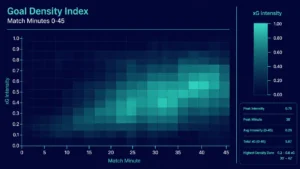
Beyond the Full-Time Result: Profiting from 1st Half Goals and xG Trends
Expected Goals (xG); many recreational bettors spend their Saturday afternoons fixated on the final whistle. They track full-time results, late...
Value Betting Software; the dream of professional sports betting is often painted as a glamorous life of intuition and “gut feelings.” In reality, the modern betting landscape is a high-frequency data war. If you are serious about long-term profitability, the question isn’t whether you need an edge, it’s how you intend to find it in a market that moves faster than ever.
The debate between manual analysis and using value betting software is a common crossroads for many bettors. Some purists argue that software strips away the “art” of handicapping, while data scientists argue that manual betting is like bringing a knife to a gunfight.
This article explores the hard truths about value betting, the role of sophisticated value betting models, and whether you can realistically compete in 2026 without digital assistance.
At its simplest, value betting is the process of identifying when a bookmaker has underpriced the probability of an outcome. If a coin flip has a 50% chance of landing on heads, the “fair” odds are 2.00 (+100). If a bookmaker offers you odds of 2.10, you have found value.
In sports, however, the “true” probability isn’t a known constant. It is an estimate. This is where value betting models come into play. These models use historical data, player metrics, and situational factors to calculate a probability that is more accurate than the one reflected in the bookmaker’s odds.
To understand why software is so prevalent, you must first understand Expected Value (EV). EV is a calculation that tells you how much you can expect to win or lose on average per bet placed on the same odds repeatedly.
The formula is:
(Probability of Winning × Amount Won per Bet) – (Probability of Losing × Amount Lost per Bet)
If the result is positive, the bet has “Positive Expected Value” (+EV). Finding these opportunities is the only way to beat the bookmaker over thousands of bets.

The short answer is yes. Technically, any individual can study a league, build a spreadsheet, and identify discrepancies. If you focus exclusively on a niche market: such as the Estonian Second Division or specific player props in a mid-tier basketball league: you might have enough specialized knowledge to spot a bad line before the market corrects it.
Manual betting allows for the inclusion of “soft data” that software might miss. A sudden managerial change, a locker room dispute, or a localized weather event that hasn’t yet hit the news wires are areas where human intuition and deep-dive research can still excel.
The problem with manual betting is not the quality of the analysis, but the limitation of human biology.
For the professional bettor, software isn’t a luxury; it’s an operational necessity. The primary function of this technology is to automate the “search and compare” phase of betting, allowing the human to focus on the “execution and management” phase.
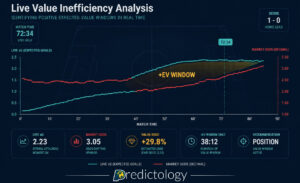
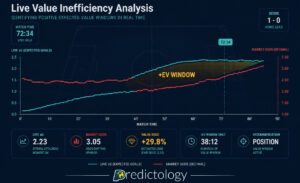
The most significant advantage of software is its ability to scan hundreds of sportsbooks in real-time. When a major sportsbook like Pinnacle moves a line, there is often a “lag” at smaller, recreational bookmakers. Software identifies this lag instantly, flagging it as a +EV opportunity. This is often referred to as “market-beating” value.
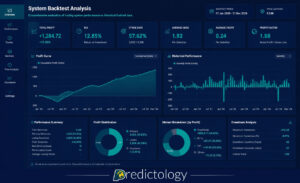
Modern tools, such as the Predictology System Builder, allow users to create and test their own value betting models. Instead of guessing, you can run a backtest on ten years of football data to see if a specific trend: like betting against home favorites after a European mid-week fixture: actually holds up.

One of the most important metrics for a professional is Closing Line Value. CLV is the comparison between the odds you took and the odds the market closed at right before the match started. If you consistently bet at 2.10 and the game starts at 1.95, you are a winning bettor in the long run, regardless of the individual game result. Software tracks this automatically, providing a “health check” for your betting strategy.
In 2026, value betting has moved beyond simple win/loss statistics. We are now in the era of xG (Expected Goals) analysis.
Traditional statistics are “outcome-based” (the score was 1-0). xG is “process-based” (the quality of chances suggested the score should have been 1-2).
Using xG value betting allows bettors to find teams that are underperforming their underlying metrics. A team might be on a five-game losing streak, making them unpopular with the public and inflating their odds. However, if their xG stats show they are dominating matches but failing to finish, a value bettor: aided by software: will see a “buy low” opportunity.
Is value betting software worth the subscription price? This depends entirely on your bankroll and your goals.
For those with limited time, the ultimate evolution of value betting is betting automation. By integrating data models with tools like BF Bot Manager, you can execute value bets 24/7 without being glued to a monitor. This removes the final hurdle of manual betting: the need to be present when the value appears.

While software is powerful, it is not a “magic button” for riches. Professional analysts understand its limitations:
You do not need software to understand value, but you almost certainly need it to exploit value at scale.
Manual betting is a fantastic way to learn the mechanics of the market. It teaches you how odds are constructed and how public sentiment influences prices. However, if your goal is to treat betting as a serious investment or a “quant” style business, manual methods will eventually lead to burnout and missed opportunities.
If you are currently betting manually, your next step shouldn’t necessarily be buying the most expensive software on the market. Instead, focus on your data foundation.
The truth is that the “house” uses the world’s most advanced software to set the lines. To beat them, you don’t need luck( you need better tools.)
August 24, 2026
Expected Goals (xG); many recreational bettors spend their Saturday afternoons fixated on the final whistle. They track full-time results, late...
August 24, 2026
In the world of football betting, 2026 marks a significant turning point. Just a few years ago, Expected Goals (xG)...
August 24, 2026
Expected Value (+EV) For the majority of football bettors, the live market is a whirlwind of emotion, reaction, and guesswork....
August 24, 2026
System Builder; for most football bettors, the journey starts with a gut feeling. You see a home team with a...
August 24, 2026
Analytics; to move from a casual punter to a professional bettor, you must transition from making “picks” to executing a...
August 24, 2026
Expected Goals (xG); many recreational bettors spend their Saturday afternoons fixated on the final whistle. They track full-time results, late...
August 24, 2026
In the world of football betting, 2026 marks a significant turning point. Just a few years ago, Expected Goals (xG)...
August 24, 2026
Expected Value (+EV) For the majority of football bettors, the live market is a whirlwind of emotion, reaction, and guesswork....
August 24, 2026
System Builder; for most football bettors, the journey starts with a gut feeling. You see a home team with a...
August 24, 2026
Analytics; to move from a casual punter to a professional bettor, you must transition from making “picks” to executing a...
Join the Discussion
We respect your privacy — your email won’t be shown. Fields marked * are required.