October 24, 2026
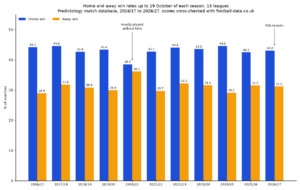
Home Advantage in 2026/27 vs the Last 10 Seasons
How strong is home advantage this season? Home, draw and away win rates in 13 leagues so far in 2026/27,...
Betting Safety; in the world of professional football betting, the difference between a successful analyst and a casual punter isn’t just about who can pick more winners. It is about who can survive the inevitable periods of variance. Even the most sophisticated statistical models encounter losing streaks: what separates the pros is a rigorous approach to bankroll protection. Without a betting safety net, a single bad run can wipe out months of disciplined growth.
Update, 14 October 2026: Autobet, which sent Predictology picks to BF Bot Manager, stops on 17 October 2026. The Bot Manager and automated-betting steps in this article won’t work with Predictology after that. Everything else in Predictology works as before.

For any bettor using a data-driven approach, understanding Expected Value (+EV) is the first step. However, +EV does not guarantee a linear path to profit. In reality, results fluctuate around a mean, a phenomenon known as variance. When those fluctuations trend downward for an extended period, we call it a drawdown.
A drawdown is the peak-to-trough decline in your betting bankroll. Even a strategy with a 60% win rate has a mathematical probability of encountering a sequence of 8 or more consecutive losses within a sample of 1,000 bets. For a beginner, this can be psychologically devastating. Predictology advocates for a process-oriented mindset where we focus on the quality of the closing line value (CLV) rather than the immediate result of a single match. By implementing betting safety rules like stop-losses and hedging, you effectively “cap” your downside, ensuring you stay in the game long enough for the law of large numbers to work in your favor.
A stop-loss is a predetermined point at which you stop running a specific strategy or exit a live trade to prevent further capital erosion. It is the ultimate tool for emotional discipline. In the heat of a live match, it is easy to “hope” for a late goal to save a position. A stop-loss removes that hope and replaces it with logic.

When setting a stop-loss, professional analysts typically look at two primary metrics:
By using the Predictology System Builder, members can test their models against over 400,000 historical matches to identify these crucial MDD and ELS figures before ever risking a single penny.
While a stop-loss protects you when things go wrong, hedging is about managing risk when things are going right: or at least when the situation is fluid. Hedging involves placing a bet on the opposite outcome of your original wager to reduce exposure or guarantee a profit.

Beginners often make the mistake of hedging too early, which can eat into long-term profits. At Predictology, we emphasize mathematical hedging over “gut feeling.” Consider these three scenarios:
Manually monitoring dozens of matches to apply stop-losses and hedges is nearly impossible for the average person. This is where automation becomes a game-changer. Professional betting isn’t about sitting in front of a screen for 10 hours a day; it’s about setting robust rules and letting technology execute them.
One of the most powerful features available to Predictology members is the full integration with BF Bot Manager. This allows you to take the strategies built in our +EV Strategy Builder and apply automated betting safety rules:

To master betting safety, you must have perfect data. Predictology’s Bet Tracker Pro provides a centralized dashboard to monitor your entire portfolio. It tracks your Closing Line Value (CLV), which is the gold standard of betting performance. If you are consistently beating the closing price but still losing money, it’s just variance: stay the course. If you are losing and not beating the closing price, your stop-loss rules should be activated immediately because your strategy has lost its edge.
The biggest obstacle to betting safety is the “get rich quick” mentality. Beginners focus on the result of the next 90 minutes. Professionals focus on the result of the next 1,000 bets.
By mastering stop-loss and hedging rules, you are essentially buying insurance for your betting career. You are acknowledging that you don’t have a crystal ball, but you do have a superior statistical model and a rigorous plan to protect your capital.

Key Takeaways for Beginners:
Successful betting is a marathon, not a sprint. By prioritizing bankroll safety today, you ensure you have the funds and the mental clarity to find the value opportunities of tomorrow.
Ready to level up? Join the Predictology LaunchPad today and get access to our full suite of analytical tools, automation guides, and a community of data-driven bettors who prioritize long-term profitability over short-term gambles.
October 24, 2026
How strong is home advantage this season? Home, draw and away win rates in 13 leagues so far in 2026/27,...
October 24, 2026
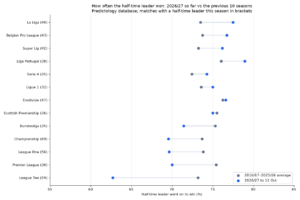
How often do half-time leads hold? Win, draw and defeat rates for half-time leaders in 13 leagues so far in...
October 24, 2026
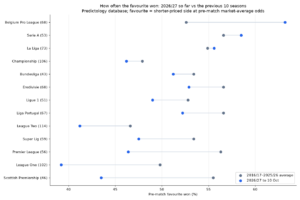
Favourites, draws and goals in 2026/27 so far compared with the previous 10 seasons across 13 leagues, from the Predictology...
October 24, 2026
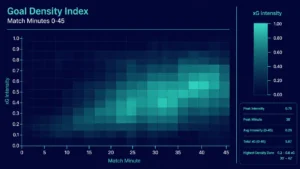
Expected Goals (xG); many recreational bettors spend their Saturday afternoons fixated on the final whistle. They track full-time results, late...
October 24, 2026
In the world of football betting, 2026 marks a significant turning point. Just a few years ago, Expected Goals (xG)...
October 24, 2026
How strong is home advantage this season? Home, draw and away win rates in 13 leagues so far in 2026/27,...
October 24, 2026
How often do half-time leads hold? Win, draw and defeat rates for half-time leaders in 13 leagues so far in...
October 24, 2026
Favourites, draws and goals in 2026/27 so far compared with the previous 10 seasons across 13 leagues, from the Predictology...
October 24, 2026
Expected Goals (xG); many recreational bettors spend their Saturday afternoons fixated on the final whistle. They track full-time results, late...
October 24, 2026
In the world of football betting, 2026 marks a significant turning point. Just a few years ago, Expected Goals (xG)...
Join the Discussion
We respect your privacy — your email won’t be shown. Fields marked * are required.