October 24, 2026
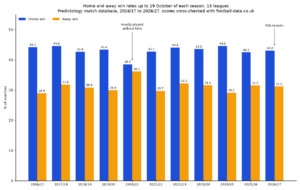
Home Advantage in 2026/27 vs the Last 10 Seasons
How strong is home advantage this season? Home, draw and away win rates in 13 leagues so far in 2026/27,...
Looking for the best value betting software? Before you buy, read our guide on the 10 essential things you need to know to find +EV opportunities and maximize your football betting profits.
Update, 14 October 2026: Autobet, which sent Predictology picks to BF Bot Manager, stops on 17 October 2026. The Bot Manager and automated-betting steps in this article won’t work with Predictology after that. Everything else in Predictology works as before.
The landscape of sports betting has shifted dramatically over the last decade. Gone are the days when a sharp eye and a morning newspaper were enough to find an edge over the bookmaker. Today, the markets are driven by sophisticated algorithms and high-frequency data feeds. To compete, serious football bettors are increasingly turning to value betting software.
At Predictology, we advocate for a data-driven approach to the markets. Value betting is not about “guessing” who will win; it is about identifying when the odds offered by a bookmaker represent a lower probability of an event occurring than the actual statistical likelihood.
However, the market for value betting tools is saturated. Some software provides a legitimate edge, while others offer little more than basic odds comparison masked as “expert” technology. Before you commit your bankroll to a subscription, here are 10 critical things you need to know.
The first thing to understand is that value betting software is fundamentally a search engine for Positive Expected Value (+EV). An edge exists when the odds (the price) are higher than the “true” probability of the outcome.
For example, if a software tool identifies a football match where the true probability of a home win is 50% (evens or 2.00), but a bookmaker is offering 2.10, that is a value bet. High-quality software scans thousands of markets simultaneously to find these discrepancies. Before buying, ensure the software clearly explains its methodology for calculating “true” odds. Most elite tools use “sharp” bookmakers: those with the highest limits and lowest margins: as the benchmark for accuracy.
In the world of betting technology, data latency is the enemy. Football markets, especially in high-profile leagues like the Premier League or Champions League, are incredibly liquid and move in seconds.
If your software has a 30-second delay in updating odds, the “value” identified has likely already been bet away by other users or adjusted by the bookmaker’s automated risk management systems. When researching software, look for providers that highlight their refresh rates. You need a platform that monitors odds movements in real-time to alert you to significant price drops or market inefficiencies before they disappear.
Not all value betting tools are created equal regarding their reach. Some platforms only scan 10–20 major European bookmakers. Others, more sophisticated options, may scan over 400 global sportsbooks.
Why does this matter? Your ability to find value is directly limited by the number of accounts you can maintain. If you are restricted to only a few “soft” bookmakers, your software needs to focus heavily on those. Conversely, if you have access to a wide range of regional or offshore books, you want software that casts a wider net. Check the “Supported Bookmakers” list before subscribing to ensure the tool aligns with your available betting accounts.
If there is one metric that determines your long-term success as a bettor, it is Closing Line Value (CLV). This is the comparison between the odds you took and the odds at the moment the match kicked off.
In the short term, betting results are subject to high levels of variance (luck). You can make ten “perfect” value bets and lose all of them. However, if you consistently beat the closing line, you are statistically guaranteed to be profitable over a large enough sample size. Professional-grade software should not just track your profit and loss; it must track your CLV. This allows you to differentiate between a bad strategy and a bad run of luck.
For more on mastering this concept, see our ultimate guide to EV betting and beating the closing line.
Value betting is a volume game. To smooth out the curve of variance, you often need to place hundreds, if not thousands, of bets per month. Doing this manually is a full-time job.
Before buying, evaluate the software’s “one-click” capabilities. Does it allow you to jump straight to the bookmaker’s bet slip? Does it offer an automated bet tracker that settles your results automatically? High-end tools save you hours of administrative work, allowing you to focus on strategy rather than data entry. If you are looking to take automation to the next level, integrating your systems with tools like BF Bot Manager can provide 24/7 coverage of the markets.

How does the software know what the “correct” price should be? This is the secret sauce of any betting technology. Most reputable value betting software uses “Sharp Benchmarking.”
Sharp bookmakers (like Pinnacle or Asian exchanges) have the most accurate lines because they allow winning bettors to play, which helps their odds settle at the most efficient price. Value betting software identifies when “soft” bookmakers (standard retail books) have failed to move their lines in sync with the sharp market. If a software provider cannot explain which bookmakers they use as their “truth” source, proceed with caution.
A “black box” approach is a red flag in sports analytics. You should be able to see the historical performance of the software’s identified value bets.
Look for software that provides a transparent dashboard of past recommendations, including the average edge percentage and the historical win rate. This data allows you to perform your own backtesting. At Predictology, we believe that the simple trick to improve your systems often lies in analyzing historical data to find where your specific edge is strongest: whether that’s in specific leagues, markets, or timeframes.
One of the harsh realities of value betting is that bookmakers do not like winners. If you consistently take +EV prices from soft bookmakers, your accounts will eventually be “limited” or “gubbed” (restricted to tiny stakes).
High-quality software should offer features to help prolong your account life. This includes:

Value betting software is an investment, not a cost. However, the math must work. If a software subscription costs £150 per month, and your total betting bankroll is only £1,000, you are starting every month with a -15% handicap.
To justify a premium software subscription, your expected monthly profit must comfortably exceed the subscription fee. Most professional bettors suggest that your monthly software cost should not exceed 10% of your expected monthly profit. Before you buy, use an EV calculator to estimate your potential returns based on your average stake and the number of bets you expect to place. You can explore different pricing and feature tiers to find a balance that fits your current bankroll.
The “firehose” approach to value betting: betting every single alert the software generates: is rarely the most efficient path. The best software allows for deep customization.
You should be able to filter for:
Value betting software is a powerful tool in a bettor’s arsenal, but it is not a “magic button” for wealth. It is a data-aggregation service that allows you to apply a professional process to the markets.
When choosing a provider, prioritize speed, CLV tracking, and benchmarking transparency over flashy marketing claims. Your goal is to build a repeatable, sustainable process that exploits market inefficiencies systematically.
Next Step: Review your current betting bankroll and determine your “volume capacity.” If you have the time to place 20+ bets a day and the bankroll to absorb the inevitable swings of variance, value betting software is likely the logical next step in your professional betting journey. Explore our features to see how data-driven insights can refine your approach.
October 24, 2026
How strong is home advantage this season? Home, draw and away win rates in 13 leagues so far in 2026/27,...
October 24, 2026
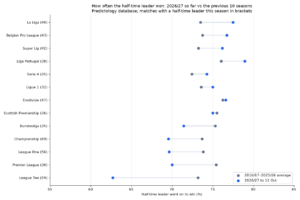
How often do half-time leads hold? Win, draw and defeat rates for half-time leaders in 13 leagues so far in...
October 24, 2026
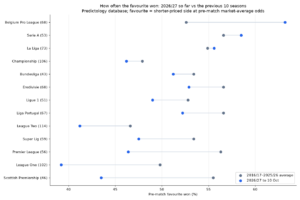
Favourites, draws and goals in 2026/27 so far compared with the previous 10 seasons across 13 leagues, from the Predictology...
October 24, 2026
Expected Goals (xG); many recreational bettors spend their Saturday afternoons fixated on the final whistle. They track full-time results, late...
October 24, 2026
In the world of football betting, 2026 marks a significant turning point. Just a few years ago, Expected Goals (xG)...
October 24, 2026
How strong is home advantage this season? Home, draw and away win rates in 13 leagues so far in 2026/27,...
October 24, 2026
How often do half-time leads hold? Win, draw and defeat rates for half-time leaders in 13 leagues so far in...
October 24, 2026
Favourites, draws and goals in 2026/27 so far compared with the previous 10 seasons across 13 leagues, from the Predictology...
October 24, 2026
Expected Goals (xG); many recreational bettors spend their Saturday afternoons fixated on the final whistle. They track full-time results, late...
October 24, 2026
In the world of football betting, 2026 marks a significant turning point. Just a few years ago, Expected Goals (xG)...
Join the Discussion
We respect your privacy — your email won’t be shown. Fields marked * are required.