September 21, 2026
Beyond the Full-Time Result: Profiting from 1st Half Goals and xG Trends
Expected Goals (xG); many recreational bettors spend their Saturday afternoons fixated on the final whistle. They track full-time results, late...
Data-driven Model; in the high-stakes world of football betting, the term “sleeper” is thrown around with reckless abandon. We see it every weekend: a pundit on a Sunday morning show claims a struggling mid-table side is a “sleeping giant” ready to wake up, or a social media tipster identifies a “hidden gem” based on a single impressive performance against a top-six side. While these narratives make for great television and engaging headlines, they are often the quickest route to a depleted bankroll.

For the serious bettor, the distinction between a narrative-driven “sleeper” and a statistically undervalued “value play” is the difference between gambling and investing. To become consistently profitable, you must learn to ignore the noise of the media and trust the cold, hard reality of your data-driven model. At Predictology, we specialise in helping you bridge that gap by providing the tools to verify or debunk every “sleeper” narrative you encounter.
The media thrives on stories. A team that has lost four games in a row but “played with heart” is a narrative. A striker who hasn’t scored in six matches but is “due a goal” is a narrative. These stories are designed to capture attention, but they rarely reflect the mathematical probability of an outcome.
The primary reason expert pundits focus on these narratives is recency bias. Humans are hardwired to give more weight to the most recent events we’ve witnessed. If a pundit saw a team play exceptionally well in their last match, even if they lost, they are likely to hype them up as a sleeper for the next fixture. However, data often tells a different story: perhaps that “impressive” performance was an outlier driven by high variance or a specific tactical matchup that won’t be repeated.
Even former players and managers, who are frequently hired as “experts,” have significant blind spots. They often rely on “gut feeling” or “dressing room atmosphere”: factors that are impossible to quantify and often misleading. Research into prediction markets consistently shows that collective intelligence and data-driven algorithms outperform individual experts because they process a much wider array of information without emotional interference.
While a pundit sees a goal that was “lucky,” a data-driven model sees an Expected Goals (xG) value. While a commentator sees a team that is “dominating,” a model sees field tilt, pass completion rates in the final third, and defensive transition metrics.

Using tools like our Live xG Analysis, you can see through the smoke and mirrors of a broadcast. A team might be under immense pressure, but if they are limiting the opposition to low-quality shots from distance, the “sleeper” value might actually lie with the defending team: contrary to what the commentator is shouting.
One of the most powerful concepts in sports modeling is regression to the mean. When the media hypes a “sleeper” because they’ve had a string of over-performances, the data model knows that statistical gravity will eventually pull them back to their average. Conversely, a team that is being written off by the media because of a “crisis” may actually be a high-value sleeper if their underlying metrics remain strong. This is where the real profit is found: betting on teams that are performing better than their results suggest.
To successfully navigate the market, you need to categorize teams based on data, not headlines. Let’s look at how to differentiate a media-hyped sleeper from a true statistical value play.

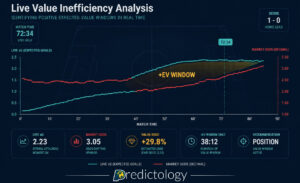
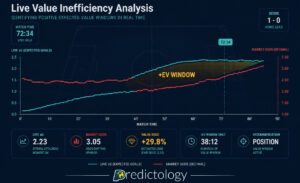
As the chart above illustrates, your goal is to find the gap where your predicted probability is higher than the probability implied by the bookmaker’s odds. When the media is busy hyping a popular team, the odds for their “boring” but statistically sound opponent often drift into value territory.
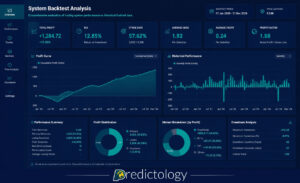
How do you move from listening to pundits to trusting your own models? The answer lies in rigorous backtesting. Instead of taking an expert’s word for it, you can use the Predictology System Builder to test if a certain “sleeper” scenario has actually been profitable over the last 400,000+ matches in our database.
You can create a model that specifically looks for undervalued teams by setting filters such as:

By following a proven framework for building models, you remove the emotional component of betting. When your system flags a play, it doesn’t matter what the “experts” on TV say. If your model has a proven 5-year track record of profitability in those exact conditions, you trust the model.
The hardest part of trusting a data-driven model over media hype is dealing with short-term variance. A pundit can be “wrong” but sound “right” because their narrative was convincing. A data model can be “right” (in terms of probability) but “lose” the bet because of a 94th-minute deflected goal.
This is why Value Betting is a marathon, not a sprint. The media will mock you when your “statistical sleeper” loses a single match, but they won’t be there 500 bets later when your bankroll has grown by 20% while the casual “sleeper” hunters are broke. Trusting the data means accepting that individual results are secondary to the quality of the process.
When a “sleeper” becomes too popular in the media, it often leads to a “steamed” market. The odds drop so low that the value vanishes. By the time the casual bettor hears about a sleeper on a major sports network, the professional syndicates have already milked the value out of the price. To find true value, you need to be ahead of the curve, using data to identify opportunities before they become public knowledge.
To stop being a victim of the “expert” punditry trap, start treating your betting like a business. Here is your roadmap:
By shifting your focus from “who will win” to “where is the value,” you align yourself with the professional 1% of bettors who take money out of the markets long-term.
Ready to build your first data-driven sleeper model? Explore our value betting tools and start letting the data speak for itself.
September 21, 2026
Expected Goals (xG); many recreational bettors spend their Saturday afternoons fixated on the final whistle. They track full-time results, late...
September 21, 2026
In the world of football betting, 2026 marks a significant turning point. Just a few years ago, Expected Goals (xG)...
September 21, 2026
Expected Value (+EV) For the majority of football bettors, the live market is a whirlwind of emotion, reaction, and guesswork....
September 21, 2026
System Builder; for most football bettors, the journey starts with a gut feeling. You see a home team with a...
September 21, 2026
Analytics; to move from a casual punter to a professional bettor, you must transition from making “picks” to executing a...
September 21, 2026
Expected Goals (xG); many recreational bettors spend their Saturday afternoons fixated on the final whistle. They track full-time results, late...
September 21, 2026
In the world of football betting, 2026 marks a significant turning point. Just a few years ago, Expected Goals (xG)...
September 21, 2026
Expected Value (+EV) For the majority of football bettors, the live market is a whirlwind of emotion, reaction, and guesswork....
September 21, 2026
System Builder; for most football bettors, the journey starts with a gut feeling. You see a home team with a...
September 21, 2026
Analytics; to move from a casual punter to a professional bettor, you must transition from making “picks” to executing a...
Join the Discussion
We respect your privacy — your email won’t be shown. Fields marked * are required.