October 24, 2026
Home Advantage in 2026/27 vs the Last 10 Seasons
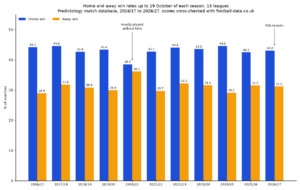
How strong is home advantage this season? Home, draw and away win rates in 13 leagues so far in 2026/27,...
The difference between a recreational bettor and a professional trader often comes down to the markets they choose to exploit. While the general public flocks to the traditional Match Odds (1X2) market, experienced professionals gravitate toward the Asian Handicap (AH) markets. Why? Because these markets are designed to balance the scales, reduce the house edge, and offer a more granular way to express a mathematical opinion on a football match.

At its core, the Asian Handicap is a form of spread betting that eliminates the possibility of a draw. By giving one team a “head start” and the other a “deficit,” the market effectively turns a three-way outcome (Home, Draw, Away) into a binary outcome.
One of the most significant reasons to switch your focus to AH is the market margin. In a standard 1X2 market, bookmakers typically bake in a margin of 5% to 7%. In contrast, highly liquid Asian Handicap markets: especially in major leagues: often feature margins as low as 2% to 3%.
For the long-term bettor, this reduction in margin is the difference between a slow drain on your bankroll and a sustainable edge. When you bet on the AH, you are essentially getting a fairer price for your probability estimates.

Pricing a market simply means calculating the “true odds” of an event occurring based on statistical data, and then comparing those odds to what the bookmaker is offering. To do this effectively for Asian Handicaps, you need to move beyond basic table positions and look at performance-based metrics.
The first step in pricing an AH line is determining the “Supremacy”: the expected goal difference between the two teams. Using the Predictology System Builder, you can analyze over 400,000 matches to see how teams with similar profiles have performed historically.
By looking at Expected Goals (xG) for and against over the last 10-20 matches, you can establish a baseline. If Team A has an xG of 1.8 and Team B has an xG of 1.2, the raw supremacy is +0.6 goals for Team A.
Data from our platform shows that home advantage varies significantly by league and even by specific team styles. You must adjust your raw supremacy figure based on:
Once you have an adjusted supremacy (e.g., Team A is a -0.75 goal favorite), you can use probability distributions to calculate the “True Price” for the -0.5, -0.75, and -1.0 lines.

You don’t need to be a math PhD to start pricing these markets. Predictology provides the infrastructure to automate much of this heavy lifting.
One of our most powerful techniques is building models that specifically track Handicap Coverage Percentage. Instead of looking at who wins the match, you can filter for how often a team covers a specific line (e.g., +0.5 or -1.25) under specific conditions.
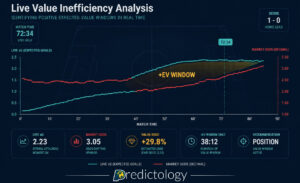
For instance, you might find that a mid-table Scandinavian team covers the +0.75 line 65% of the time when playing away against top-four opposition. If the bookmaker is pricing that +0.75 line at 2.00 (implied 50%), you have found a massive +EV opportunity.
Our +EV Strategy Builder tracks over 20,000 bets to identify where the market has consistently failed to price in data-driven trends. When the model probability significantly deviates from the bookmaker’s implied probability in the AH market, the strategy builder flags it as a high-value opportunity.
Professional bettors use these tools to find “stale lines” where the market hasn’t yet reacted to the underlying data shifts.

One aspect of AH that many beginners ignore is the split handicap (e.g., -0.25, -0.75, +1.25). These lines are crucial for managing variance.
A -0.75 handicap is actually two separate bets: half your stake on -0.5 and half on -1.0. If your team wins by exactly one goal, you win half your bet and get the other half refunded. This “insurance” is why AH markets are less volatile than the 1X2 market, where a single late goal can turn a win into a total loss.
By using Predictology’s detailed match analytics, you can determine if a match is likely to be a “tight win” or a “blowout,” allowing you to choose between a -0.5 or a -1.0 line with much higher confidence.
Ignoring Asian Handicap markets means leaving money on the table. The combination of lower margins, reduced volatility, and the ability to find edges through data-driven supremacy modeling makes it the primary tool for any serious bettor.
Your next step is simple: Stop looking at the 1X2 odds and start using the Predictology System Builder to calculate your own supremacy lines. When you see a discrepancy between your model and the market, you’ve found your edge.
Practical Takeaway: Start by tracking the AH -0.5/0.0 (+0.25/-0.25) lines for your favorite league. Compare the Predictology xG-based supremacy to the closing lines for 10 matches. You will quickly see how often the market misprices the likelihood of a tight draw or a marginal win.
Ready to take your betting to the professional level? Join Predictology today and access the data you need to price the markets like a pro.
October 24, 2026
How strong is home advantage this season? Home, draw and away win rates in 13 leagues so far in 2026/27,...
October 24, 2026
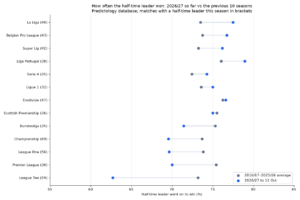
How often do half-time leads hold? Win, draw and defeat rates for half-time leaders in 13 leagues so far in...
October 24, 2026
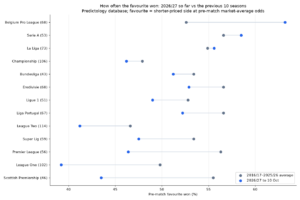
Favourites, draws and goals in 2026/27 so far compared with the previous 10 seasons across 13 leagues, from the Predictology...
October 24, 2026
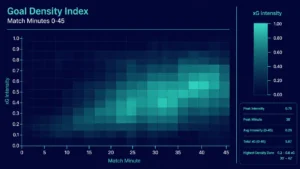
Expected Goals (xG); many recreational bettors spend their Saturday afternoons fixated on the final whistle. They track full-time results, late...
October 24, 2026
In the world of football betting, 2026 marks a significant turning point. Just a few years ago, Expected Goals (xG)...
October 24, 2026
How strong is home advantage this season? Home, draw and away win rates in 13 leagues so far in 2026/27,...
October 24, 2026
How often do half-time leads hold? Win, draw and defeat rates for half-time leaders in 13 leagues so far in...
October 24, 2026
Favourites, draws and goals in 2026/27 so far compared with the previous 10 seasons across 13 leagues, from the Predictology...
October 24, 2026
Expected Goals (xG); many recreational bettors spend their Saturday afternoons fixated on the final whistle. They track full-time results, late...
October 24, 2026
In the world of football betting, 2026 marks a significant turning point. Just a few years ago, Expected Goals (xG)...
Join the Discussion
We respect your privacy — your email won’t be shown. Fields marked * are required.