September 20, 2026
Beyond the Full-Time Result: Profiting from 1st Half Goals and xG Trends
Expected Goals (xG); many recreational bettors spend their Saturday afternoons fixated on the final whistle. They track full-time results, late...
xG Expected Goals; for decades, football fans and bettors alike have relied on a singular, often deceptive metric to judge a game: the scoreline. We’ve all seen it: a team dominates for 90 minutes, hits the woodwork twice, misses a sitter from three yards, and then loses 1-0 to a 90th-minute counter-attack. In the eyes of the history books, they lost. In the eyes of a professional football trader, however, the narrative is entirely different.
The emergence of Expected Goals (xG) has fundamentally shifted how we analyze performance. While once a niche metric used by data scientists and elite clubs, football xG stats have become the primary tool for anyone looking to find an edge in the betting markets. If you are still trading based on shots on target or “gut feeling,” you are leaving money on the table.
In this guide, we will explore why xG is the ultimate “truth serum” for football markets and how you can use xG live trading tools to outmaneuver the casual betting public.
To understand why xG is superior, we must first look at why traditional stats fail us. Most retail bettors look at possession, total shots, and shots on target. While these provide a “vibe” of the game, they are frequently misleading.
A shot from 35 yards that the keeper comfortably catches counts as a “shot on target.” A point-blank header from a corner that is cleared off the line also counts as a “shot on target.” In the traditional stats column, these two events are equal. In reality, they are worlds apart.
The 35-yard shot might have an xG value of 0.02 (a 2% chance of scoring), while the point-blank header might be 0.65 (a 65% chance). Professional football traders know that the team creating high-value chances is far more likely to score in the long run than the team simply padding their shot count with speculative efforts.
Goals are rare events. Because they happen so infrequently, they are prone to extreme variance: or what we call “luck.” A deflection, a refereeing error, or a momentary lapse in concentration can result in a goal that doesn’t reflect the underlying play. Football xG stats strip away this noise. They measure the quality of the chances created, providing a more stable and predictive indicator of which team is actually performing better.
While pre-match xG is vital for identifying value, its true power is unlocked during inplay football trading. This is where the discrepancy between the “perceived” state of the game and the “actual” performance of the teams creates massive opportunities.
The betting markets, particularly on exchanges like Betfair, move aggressively when a goal is scored. However, markets are often slow to react to “non-events” that have high statistical significance.
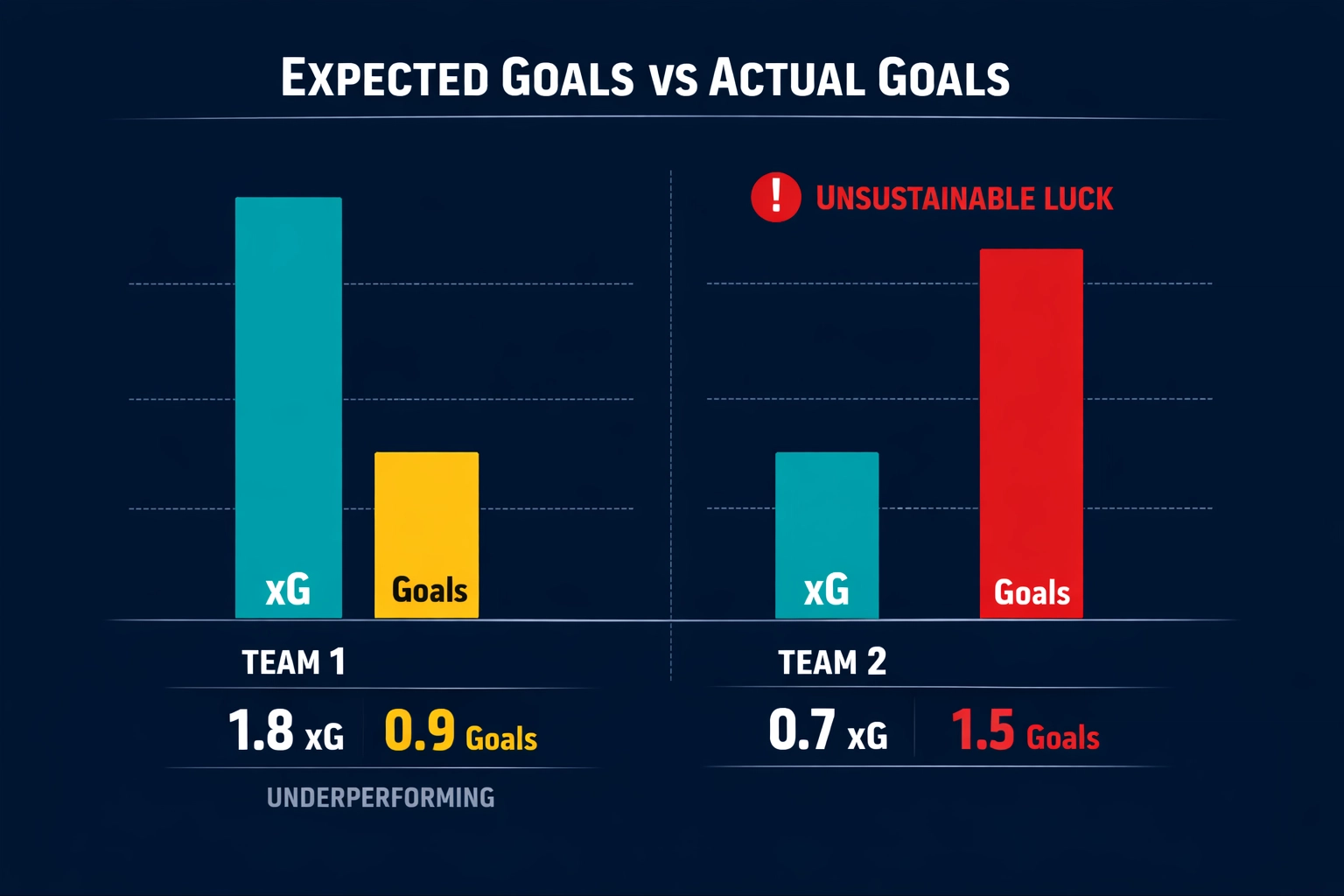
For example, if a heavy favorite is drawing 0-0 at half-time but has accumulated 1.8 xG, the “Under 2.5 Goals” price might start to drop as casual bettors assume it’s a “boring” game. The professional trader sees the 1.8 xG and knows that a goal is statistically overdue. This is the perfect time to back the favorite or the “Over” markets at an inflated price.
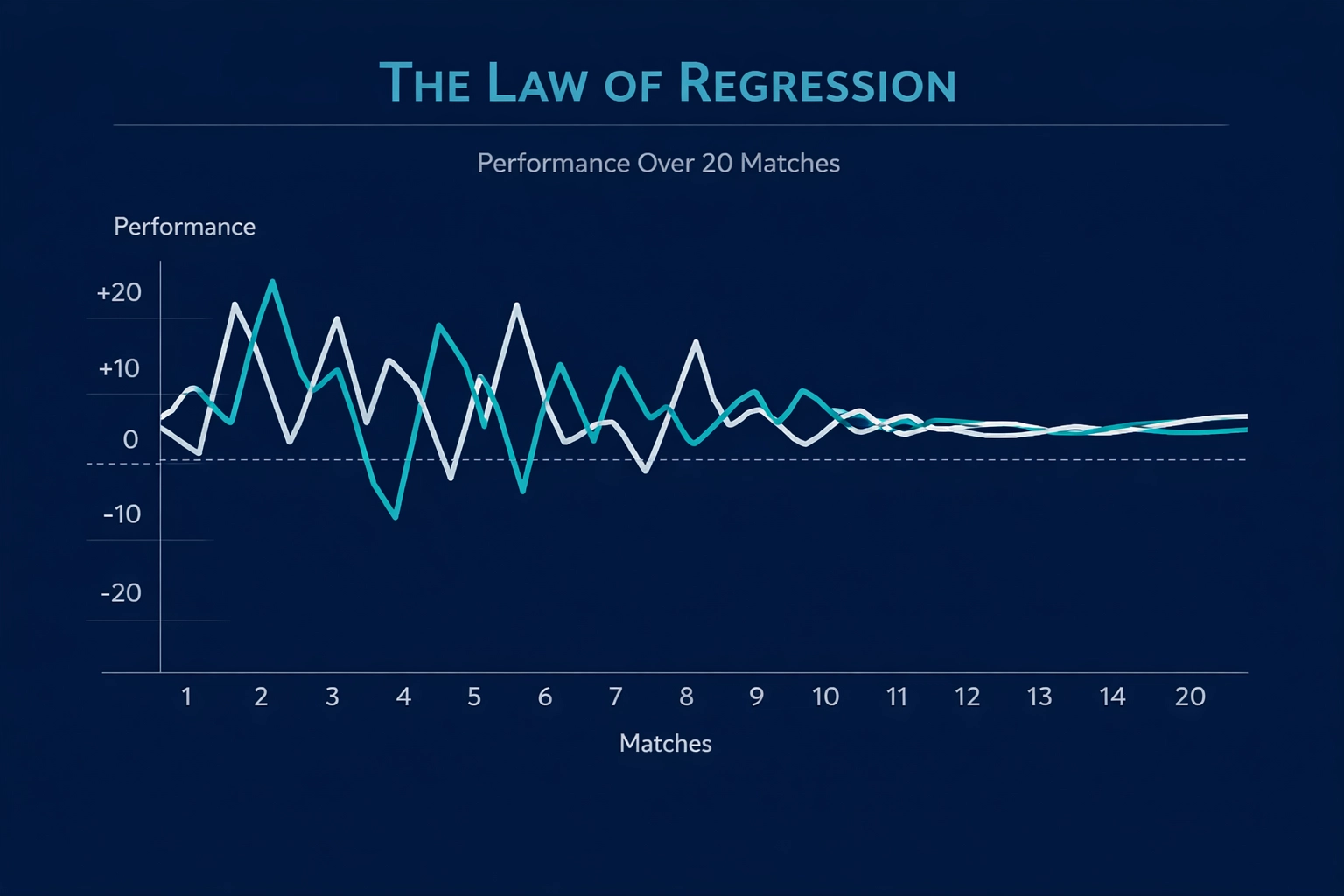
One of the most powerful concepts in football trading strategies is regression to the mean. Over a long enough timeline, a team’s goals scored will almost always align with their xG.
If a team has scored 2 goals from an xG of 0.4, they are massively overperforming. They have been lucky or have benefited from world-class finishing that is unsustainable. In a live environment, if you see a team leading 1-0 but their xG is abysmal (e.g., 0.05), they are a prime candidate for a “Lay” bet. The market sees a winning team; the data sees a team under immense pressure that is likely to buckle.
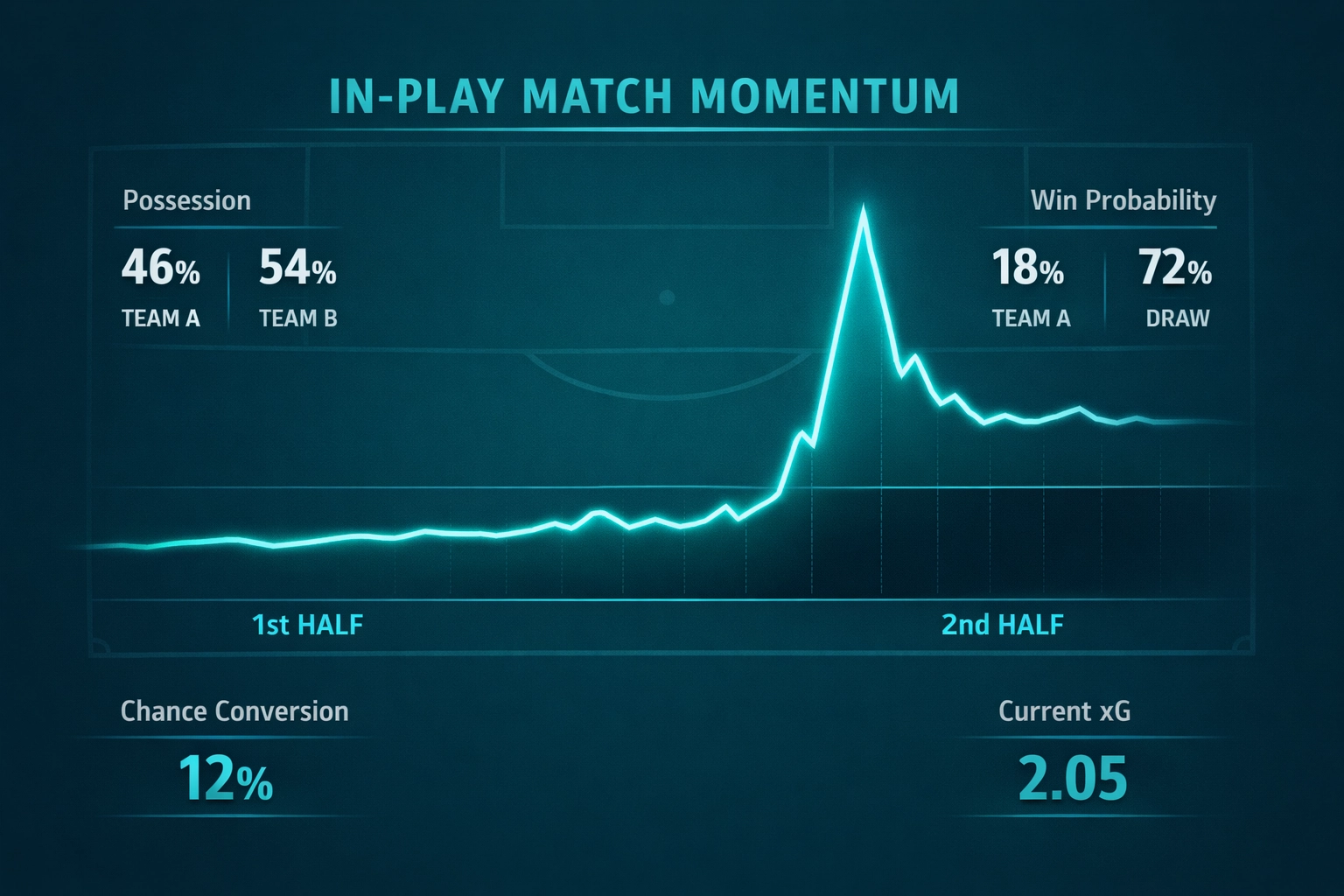
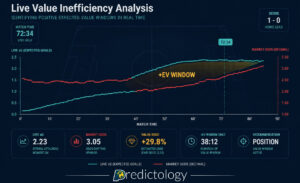
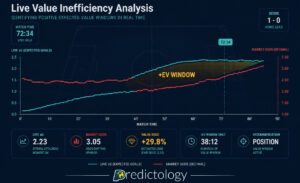
To trade effectively in-play, you cannot rely on manual calculations. You need real-time data. This is where xG live trading tools become essential. These tools allow you to monitor dozens of matches simultaneously, flagging games where the stats diverge from the scoreline.
At Predictology, we emphasize a data-first approach. Using our tools, you can filter for specific in-play scenarios. For example, you can set an alert for games where:
This specific setup identifies a “dominant” draw, where the pressure is building, and the market is likely underestimating the probability of a late home win. By using these football trading strategies, you aren’t guessing; you are following a mathematical edge. You can learn more about refining your approach in our guide on the simple trick to improve your football betting systems right now.
To help you get started, here are three ways to integrate football xG stats into your daily trading routine.
This strategy targets matches where an underdog has taken an early lead against the run of play.
This is a classic inplay football trading move targeting the final 20 minutes of a game.
Many traders avoid games that look like stalemates. However, some of the best value is found in 0-0 games that are actually high-quality encounters.
Beyond the numbers, xG provides a massive psychological advantage. Trading can be an emotional rollercoaster. When you lose a bet on a 90th-minute goal, it’s easy to feel like the world is against you.
When you use football xG stats, you move away from result-oriented thinking and toward process-oriented thinking. If you consistently place trades where the xG supports your position, you are making “correct” decisions regardless of the individual outcome. In the world of professional betting, the process is everything.
The gap between casual bettors and professional traders is widening. As the markets become more efficient, the only way to stay ahead is to use the same tools the professionals use. xG live trading tools provide a window into the “true” state of a match, allowing you to find value that others simply cannot see.
If you’re ready to stop guessing and start trading with mathematical precision, it’s time to integrate advanced analytics into your workflow.
Practical Takeaway: Next time you are looking at an in-play match, ignore the shots on target. Look at the xG per shot. A team with 5 shots and 1.0 xG is a far better trading prospect than a team with 15 shots and 0.5 xG.
At Predictology, we provide the platform, the data, and the community to help you master these metrics. Don’t trade in the dark: use the power of xG to illuminate your path to consistent returns.
Ready to dominate the in-play markets? Join Predictology today and get access to the ultimate xG live trading tools.
September 20, 2026
Expected Goals (xG); many recreational bettors spend their Saturday afternoons fixated on the final whistle. They track full-time results, late...
September 20, 2026
In the world of football betting, 2026 marks a significant turning point. Just a few years ago, Expected Goals (xG)...
September 20, 2026
Expected Value (+EV) For the majority of football bettors, the live market is a whirlwind of emotion, reaction, and guesswork....
September 20, 2026
System Builder; for most football bettors, the journey starts with a gut feeling. You see a home team with a...
September 20, 2026
Analytics; to move from a casual punter to a professional bettor, you must transition from making “picks” to executing a...
September 20, 2026
Expected Goals (xG); many recreational bettors spend their Saturday afternoons fixated on the final whistle. They track full-time results, late...
September 20, 2026
In the world of football betting, 2026 marks a significant turning point. Just a few years ago, Expected Goals (xG)...
September 20, 2026
Expected Value (+EV) For the majority of football bettors, the live market is a whirlwind of emotion, reaction, and guesswork....
September 20, 2026
System Builder; for most football bettors, the journey starts with a gut feeling. You see a home team with a...
September 20, 2026
Analytics; to move from a casual punter to a professional bettor, you must transition from making “picks” to executing a...
Join the Discussion
We respect your privacy — your email won’t be shown. Fields marked * are required.